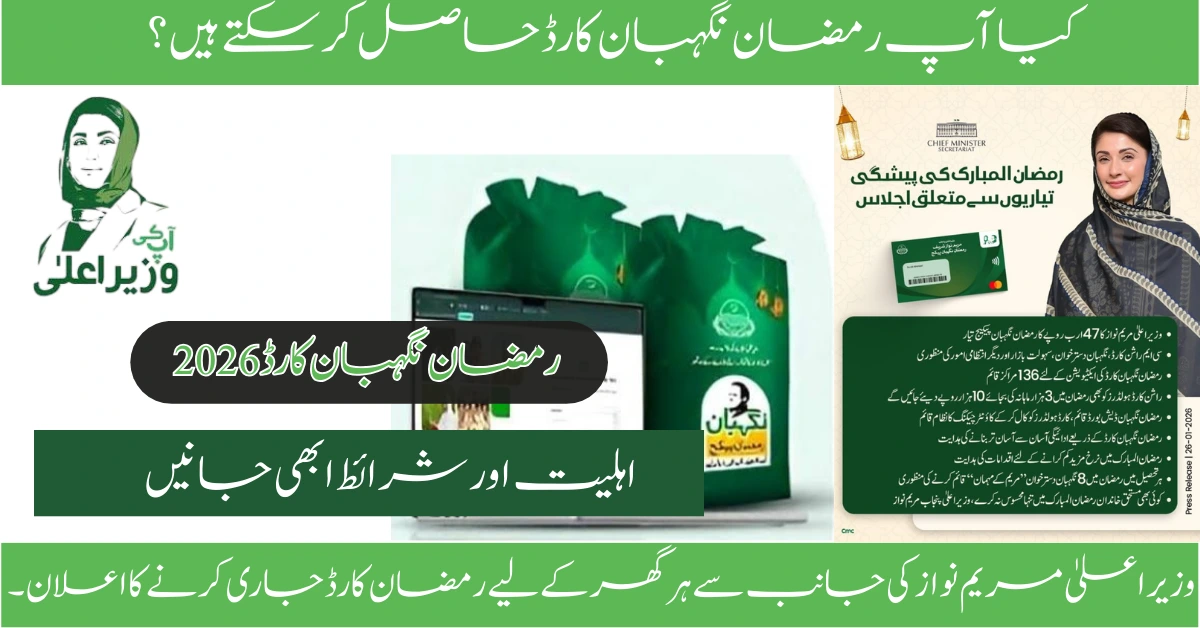
With inflation hitting 20%+ annually and food prices skyrocketing, the question “Who is Eligible for Ramzan Nigehban Card 2026” is being asked by millions of Pakistani families. The Punjab Government, under Chief Minister Maryam Nawaz Sharif, has launched one of the country’s largest welfare initiatives—a historic Rs. 47 billion package designed to support approximately 4.2 million deserving families with Rs. 10,000 cash assistance during Ramadan.
But here’s the confusion: Different provinces have different programs, eligibility criteria vary, and many families aren’t sure if they qualify. Are you eligible? What exactly does the government look for? And what happens if you don’t meet one criterion?
This complete eligibility guide answers every question. We’ve analyzed the official criteria, clarified the differences between federal (9999) and Punjab (8070) programs, explained what “PMT score” actually means, and provided the exact steps to verify your eligibility. By the end, you’ll know precisely whether you qualify for Ramzan Nigehban Package 2026 and what to do next.
What is the Ramzan Nigehban Package 2026?
Before understanding eligibility, let’s clarify what this program actually is.
The Ramzan Nigehban Package 2026 (also called Nigehban Ramadan Package, Nigehban Card, or Ramzan Relief Package) is a welfare initiative launched by the Punjab Government. It’s not a single nationwide program—it’s specifically for Punjab residents.
Key Program Facts:
- Total Budget: Rs. 47 billion
- Target Beneficiaries: 4.2 million families (approximately 10 million individuals)
- Cash Assistance: Rs. 10,000 per eligible family
- Delivery Method: Nigehban ATM Cards, direct bank transfer, mobile wallets, or door-to-door delivery
- Duration: Distributed during the month of Ramadan (Ramzan 2026)
- Managed By: Punjab Government, Chief Minister’s Office
- Linked With: Punjab Socio-Economic Registry (PSER)
Important Distinction: This is different from the federal “9999 PM Ramzan Package” or the “8070 Federal Atta Scheme.” If you’re in Sindh, KP, or Balochistan, you need to check your provincial programs separately.
Complete Eligibility Criteria for Ramzan Nigehban Package 2026
Here’s the official eligibility framework that determines who gets the Rs. 10,000 and who doesn’t:
Mandatory Basic Requirements
1. Permanent Residency
- You must be a permanent resident of Punjab (all districts)
- Proof: Your CNIC must show a Punjab address
- Note: If you’ve migrated from another province but updated your CNIC, you’re eligible
2. Valid 13-Digit CNIC
- You must possess a valid, non-expired Computerized National Identity Card (CNIC) from NADRA
- The CNIC must be active and verified with your mobile number
- Temporary CNICs or B-Forms alone don’t qualify
3. Monthly Family Income Threshold
- Your total household monthly income must be under Rs. 45,000-60,000 per month (exact threshold may be revised upward in 2026)
- This includes income from all family members combined
- Includes salaries, wages, business income, agricultural income, and rental income
- Important: Government employees earning above Rs. 25,000/month are typically ineligible
4. Poverty Means Test (PMT) Score Below 30%
- Your household must have a PMT score below 30% as verified through PSER database
- This is the most complex criterion—explained in detail below
Understanding the PMT Score: The Criterion Most People Misunderstand
The Poverty Means Test (PMT) Score is what confuses 70% of applicants. Let’s break it down:
What is a PMT Score?
The PMT score is a calculated indicator of your household’s poverty level. It’s NOT a single score you can see; it’s computed by the government based on multiple factors about your living situation.
Factors Used to Calculate Your PMT Score:
| Factor | What Matters | Example |
|---|---|---|
| Housing Type | Permanent brick house (higher score) vs. mud house (lower score) | Mud/katchi house = lower poverty = harder to qualify |
| Electricity Access | Having a meter, solar, or generator vs. no access | Families with meters score higher |
| Water Source | Piped water vs. well/hand pump | Hand pumps indicate lower income |
| Sanitation | Flush toilet vs. outdoor toilet | Flush toilets increase your score |
| Household Assets | Vehicle ownership, land, machinery, livestock | Owning a car instantly disqualifies you |
| Family Members’ Jobs | If anyone is employed/salaried | Government jobs disqualify you entirely |
| Education Level | Literacy of household head | Basic literacy affects scoring |
| Marital Status | Widows/divorced get priority (lower threshold) | Widow status lowers your needed score |
The Critical PMT Rule: “Below 30%”
If your PMT score is below 30%, you’re considered poor enough to qualify. If it’s 30% or above, you’re disqualified regardless of income.
What This Means in Practice:
- A family living in a mud house with no vehicle = PMT ~15-20% (Qualifies easily)
- A family in a brick house with a car = PMT ~50%+ (Disqualified immediately)
- A widow in a simple house = PMT ~20-25% (Qualifies)
The Government’s Logic: They’re not just looking at money—they’re looking at your overall poverty level.
Who is Definitely Eligible?
These groups almost always qualify for Ramzan Nigehban Package 2026:
✅ Widows & Widowers
- Especially if you updated your CNIC status to “Widow” with NADRA
- Even with income below Rs. 60,000
- Priority beneficiaries—often auto-included in the system
✅ Daily Wage Workers
- Construction workers, farm laborers, house staff
- If your monthly income is documented as under Rs. 45,000
- PSER already has records of most registered daily workers
✅ Disabled Persons
- With disability certificate from government hospital
- Even if household income is slightly above threshold
- Given priority in distribution
✅ Female-Headed Households
- Unmarried mothers, divorced women, widows
- Typically given priority status
✅ Families with Multiple Children (5+)
- Especially if primary earner has low income
- School-going children reduce eligibility threshold
✅ Families Already Receiving Rashan Card (Maryam Nawaz Card)
- If you currently get Rs. 3,000/month from Rashan Card
- You’re auto-included in the system without re-applying
- Cash assistance will be upgraded to Rs. 10,000 during Ramadan
✅ People Who Received the Package in Previous Years (2023-2025)
- If you were eligible last year, you likely remain eligible in 2026
- PSER updates automatically—you don’t need to re-register
- You’ll be auto-included if data hasn’t changed
Who is Definitely Ineligible?
These groups CANNOT get Ramzan Nigehban Package 2026, regardless of income:
❌ Government Employees & Pensioners
- Civil servants, military personnel, teachers, nurses (all government servants)
- Even if officially earning Rs. 25,000/month
- This includes anyone on government payroll
❌ Business Owners with Significant Assets
- Shopkeepers, industrialists, contractors
- Even if claiming low profits
- Government doesn’t distinguish between sole proprietors and corporations
❌ Vehicle Owners
- Any registered car, motorcycle, auto-rickshaw, or truck in your name
- Even if the vehicle is paid off
- E-bikes and motorcycles used for work may have different rules (verify locally)
❌ People with Family Members Abroad
- If your spouse, child, or parent is living in a foreign country
- Implies access to foreign remittances, even if not documented
❌ Tax Filers
- If you’ve filed income tax returns in the past 3 years
- Government assumes tax filers have sufficient income
- Being on the FBR (Federal Board of Revenue) list disqualifies you
❌ Receiving Other Government Welfare Programs
- BISP Kafaalat: If you get Rs. 13,500 quarterly, you can’t get Nigehban
- Ehsaas Programs: Dual benefits are typically avoided
- Other Provincial Assistance: Having benefits from another province affects eligibility
- Exception: Rashan Card (Rs. 3,000) is compatible—you’ll get upgraded to Rs. 10,000
❌ Property Owners
- Agricultural land (beyond subsistence farming)
- Commercial property
- Multiple residential properties
- If you own agricultural land, verify with local office—some exceptions exist
The Critical Difference: Auto-Eligible vs. New Applicants
This is where competitors’ content fails. Most families don’t need to apply; they’re auto-eligible through PSER.
If You’re Already in PSER Database (Likely Auto-Eligible)
You’re auto-included if:
- You’ve received Rashan Card before (Maryam Nawaz Card)
- You registered for PSER survey in 2023-2025
- You’re on any government welfare program list (excluding BISP)
- Your family was interviewed by government surveyors
What You Need to Do:
- Send your CNIC via SMS to 8070
- Wait for confirmation message (arrives within 24 hours)
- No further action needed—card will be delivered to your home
Timeline:
- SMS confirmation: Same day
- Card delivery: By late February/early March 2026 (before Ramadan)
- Cash access: Immediate after card activation
If You’re NOT in PSER Database (Need to Register)
You need to apply if:
- You’ve never registered with PSER before
- Your family missed the previous surveys
- You migrated to Punjab recently
- Your data is outdated (moved house, family changes)
How to Register:
- Visit https://pser.punjab.gov.pk
- Click “Register New Family”
- Enter CNIC, mobile number, family details
- Answer all socio-economic questions honestly
- Upload B-Forms of children (if applicable)
- Submit and wait for NADRA verification (7-14 days)
- After verification, send CNIC to 8070 to confirm eligibility
Timeline for New Applicants:
- Online registration: Same day
- NADRA verification: 7-14 days
- Eligibility check: After verification
- Card delivery: Approximately 4-6 weeks (may miss early Ramadan)
Step-by-Step Eligibility Verification for Ramzan Nigehban Package 2026
Method 1: SMS Verification (Fastest – 2 Minutes)
Step 1: Send SMS
- Open your mobile SMS app
- Type your 13-digit CNIC number (WITHOUT dashes or spaces)
- Example: If your CNIC is 35201-1234567-8, type as 3520112345678
- Send to: 8070 (or try 8171 if 8070 doesn’t work)
Step 2: Wait for Reply
- You’ll receive an SMS within 5-30 minutes
- If Eligible: “Congratulations! You are eligible for the Nigehban Ramzan Package 2026. Your card will be delivered to your address.”
- If Ineligible: “We regret to inform you that you are not eligible. [Reason provided]”
Common Ineligibility Reasons via SMS:
- “Vehicle registered in your name”
- “Family member abroad”
- “Already receiving federal assistance”
- “PMT score above threshold”
- “Data not found in system—please register”
Method 2: Online Status Check (Detailed – 5-10 Minutes)
Step 1: Visit Official Portal
- Go to: https://pser.punjab.gov.pk
- This is the ONLY official portal (beware of fake websites)
Step 2: Check Your Status
- Click “Check Status” or “Login”
- Enter your CNIC number
- Enter your registered mobile number
- The system will show:
- Your current PSER registration status
- Your family’s PMT score
- Your eligibility for various Punjab programs
- Expected Nigehban benefit amount
Step 3: Interpret Your Results
- Status: Registered, Verified → You’re eligible (or check specific reasons)
- Status: Pending Verification → Your data is being checked (wait 7-14 days)
- Status: Rejected → You’re ineligible (reasons shown on screen)
Method 3: In-Person Verification (Most Detailed – 30 Minutes)
If online methods fail or give unclear results:
Step 1: Visit Your Local Union Council (UC) Office
- Bring your original CNIC
- Bring family B-Forms (for children)
- Ask to speak with the PSER representative
Step 2: What the UC Staff Will Check
- Your CNIC verification with NADRA
- Your PSER registration status
- Why you might be ineligible
- How to update your data if needed
Step 3: Request Data Update
- If data is wrong, ask for corrections
- Staff can update income information
- They can add missing family members
- The correction takes 2-7 days to process in the system
Step 4: Follow Up
- Return to UC after 7 days
- Get a verification stamp
- Send SMS to 8070 again
Common Eligibility Questions & Answers
“I’m rejected because I own a registered motorcycle. Can I get it transferred to someone else?”
Answer: Possibly, but you must:
- Complete the transfer officially with EXCISE before applying
- Wait 15 days for the system to update
- Then apply again
Simply giving the bike to a family member without official transfer still counts as your property.
“My husband works abroad but doesn’t send money. Does this make me ineligible?”
Answer: Yes, technically. The criterion is “no family member abroad,” not “no remittance.” However:
- If you’ve been separated/divorced, update your CNIC to “divorced”
- If your husband abandoned you without support, visit UC with proof (divorce papers, FIR, etc.)—they may make an exception
- Widow status has priority
“I’ve never registered for PSER. Can I still apply for Ramzan Nigehban in 2026?”
Answer: Yes, but with delays:
- Register online at pser.punjab.gov.pk immediately (don’t wait)
- NADRA verification takes 7-14 days
- You’ll likely get eligibility confirmation by mid-Ramadan (possibly too late for early distribution)
- You’ll still receive your Rs. 10,000 as back payment after confirmation
Recommendation: Apply this week if you haven’t registered yet.
“My PMT score is exactly 30%. Am I eligible?”
Answer: No. The rule is “below 30%,” meaning:
- 29.9% = Eligible ✓
- 30% = Ineligible ✗
- 30.1% = Ineligible ✗
If your score is at 30%, you’re outside the window. However, you can request a re-survey through your UC office to update poverty assessment.
“I received Rashan Card (Rs. 3,000). Will the Nigehban Package (Rs. 10,000) replace it or add to it?”
Answer: During Ramadan:
- Your Rs. 3,000 Rashan Card benefit CONTINUES
- PLUS you get Rs. 10,000 Nigehban cash
- Total during Ramadan: Rs. 13,000 (highest relief)
- After Ramadan, you drop back to Rs. 3,000 only
This is the government’s strategy to maximize relief during the holy month.
“I work as a daily wage laborer but earn more than Rs. 45,000 some months. Am I ineligible?”
Answer: It depends on your average:
- If your average monthly income over 12 months is below Rs. 45,000, you’re eligible
- PSER looks at annual income divided by 12, not peak months
- If you worked full 12 months and earned Rs. 600,000 total = Rs. 50,000/month average = likely ineligible
Be honest in your survey—the government has access to bank records, tax data, and utility bills.
What Happens After You’re Confirmed Eligible?
Timeline: When Will You Get Your Money?
If Auto-Eligible (Already in PSER):
- SMS Confirmation: 1 day after sending CNIC to 8070
- Card Delivery: 5-14 days (door-to-door or distribution center)
- Money Access: Immediate after card activation at ATM/bank
If New Registrant:
- Registration to Verification: 7-14 days
- SMS Confirmation: After verification
- Card Delivery: 14-21 days after confirmation
- Money Access: Immediate after card activation
Actual Distribution Window:
- Expected: Late February 2026 (before Ramadan starts)
- Latest: Mid-March 2026 (early Ramadan)
- Latest for back payment: By end of Ramadan
How to Collect Your Rs. 10,000
Once confirmed eligible, you’ll receive a notification SMS. Here’s what to do:
Option 1: Nigehban ATM Card (Recommended)
- You’ll receive a physical card at your address
- Go to any Bank of Punjab (BOP) ATM or 1-Link ATM
- Insert card, enter PIN (sent separately via SMS)
- Withdraw Rs. 10,000 cash
- Pros: No crowds, convenient, private
- Cons: Must have ATM access in your area
Option 2: Direct Bank Transfer
- If you provide a bank account number
- Rs. 10,000 will be deposited directly
- Available for withdrawal immediately
- Requires active account (savings or current)
Option 3: Mobile Wallet (JazzCash/Easypaisa)
- Money sent to your registered mobile number
- Withdraw from any JazzCash or Easypaisa agent
- Fast, widely accessible
Option 4: Biometric Cash Collection
- Government sets up collection camps in your district
- Bring your CNIC
- Fingerprint verification and Rs. 10,000 cash disbursed
- Pros: Doesn’t require bank account or ATM
- Cons: May involve queues; check local schedule
Option 5: Door-to-Door Delivery
- For very elderly or disabled individuals
- Government staff delivers cash to your home
- You provide thumbprint on receipt
- Request this at your Union Council
Eligibility Criteria Comparison Table
Here’s a quick reference showing which situations make you eligible or ineligible:
| Situation | Eligible? | Notes |
|---|---|---|
| Monthly income Rs. 40,000, PMT <30%, no vehicle | ✅ YES | Clear case |
| Monthly income Rs. 50,000, PMT <30%, no vehicle | ❓ MAYBE | Depends on PMT; close to threshold |
| Monthly income Rs. 35,000, owns a car | ❌ NO | Vehicle ownership disqualifies |
| Widow, income Rs. 50,000, PMT <30% | ✅ YES | Widow status gives priority |
| Government employee, income Rs. 40,000 | ❌ NO | Government employees ineligible |
| Rashan Card holder, income Rs. 55,000 | ✅ YES | Already verified; auto-upgraded during Ramadan |
| Tax filer, monthly income Rs. 35,000 | ❌ NO | Tax filing indicates higher capacity |
| Retired pensioner, income Rs. 30,000 | ❌ NO | Pensions are government income |
| Self-employed shopkeeper, income Rs. 45,000 | ❌ LIKELY NO | Business owners typically ineligible |
| Laborer, income Rs. 30,000, child working abroad | ❌ NO | Family member abroad disqualifies |
| Widow, income Rs. 60,000, PMT <30%, no assets | ✅ LIKELY | Widow priority overrides some criteria |
What If You’re Rejected? How to Appeal
If you receive an ineligibility message, don’t lose hope. Many rejections can be overturned:
Step 1: Understand Your Ineligibility Reason
The SMS or online portal will show WHY you’re ineligible:
- “Vehicle registered in your name”
- “PMT score above 30%”
- “Family member abroad”
- “Already receiving federal assistance”
- “Government employee”
- Other specific reason
Step 2: Verify the Information Is Correct
Visit your local Union Council and check:
- Is the vehicle registration actually in your name? (Maybe it’s a relative’s)
- Is the family member abroad? (Maybe they’ve returned)
- Is the PMT score accurate? (Survey data may be outdated)
Step 3: Request a Data Update/Re-Survey
If information is wrong:
- Bring original documents (CNIC, vehicle ownership proof, etc.)
- Request a data correction
- Ask for a re-survey (takes 2-7 days)
- After update, send CNIC to 8070 again
Step 4: Formal Appeal (If Needed)
If the UC can’t help:
- Contact your District Officer PSER
- File a written appeal with documentation
- Include proof that your situation has changed
- Decision usually within 2 weeks
Example Appeals That Work:
- “I sold my vehicle (attach receipt)”
- “My family member returned from abroad (attach CNIC update)”
- “The income information is wrong; here’s my actual income (attach tax returns or bank statements)”
Provincial Variations: Not Just Punjab?
Important: Different provinces have DIFFERENT programs in 2026.
Punjab (8070 / Nigehban)
- Rs. 47 billion budget
- 4.2 million families
- Rs. 10,000 cash
- Monthly income threshold: Rs. 45,000-60,000
- PMT <30%
- Check: Send CNIC to 8070
Federal / Prime Minister’s Package (9999)
- Nationwide but with different criteria
- Rs. 5,000 cash (vs. Rs. 10,000 in Punjab)
- Different eligibility rules
- Check: Send CNIC to 9999
Sindh
- Has own provincial Ramadan package (not Nigehban)
- Different criteria and amounts
- Managed by Sindh government separately
KP (Khyber Pakhtunkhwa)
- Separate KP Ramadan relief program
- Not connected to Punjab’s Nigehban
Balochistan
- Provincial relief program
- Limited compared to Punjab/Sindh
Which One Applies to You?
- If you live in Punjab = Nigehban (8070) is primary
- If you live in other provinces = Check your provincial government website
- You can apply for BOTH Punjab (8070) and Federal (9999) if eligible, but typically only one will approve to avoid duplication