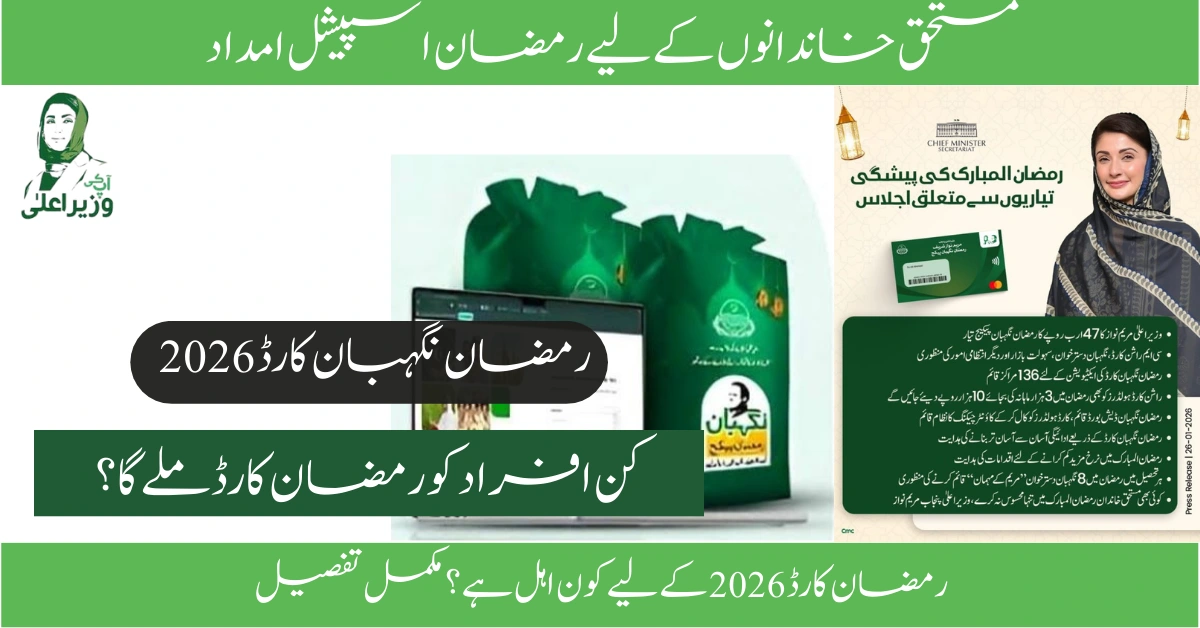
If you’re searching for “Who is eligible for Ramzan card 2026,” you’re asking one of the most important questions as Ramadan approaches. With inflation pushing grocery prices higher every year, thousands of Pakistani families are wondering if they qualify for this relief program. The Ramzan card eligibility 2026 requirements have been updated, and understanding them correctly could mean the difference between receiving Rs. 10,000-13,000 in cash assistance or being left out.
This comprehensive guide explains every eligibility criterion for the 2026 Ramzan card program—both the federal PM Ramzan Package and Punjab’s Nigehban program. You’ll discover who qualifies, who gets rejected (and why), how the PMT scoring system works, and what you must do to secure your eligibility before Ramadan begins. Unlike other articles that skim the surface, this guide dives deep into the actual disqualification reasons, priority categories, and real solutions when you face common problems like “No Record Found.”
What is the Ramzan Card 2026?
Who is Eligible for Ramzan Card 2026 is a direct cash assistance program launched by the government to help low-income families manage rising food costs during the holy month. Two main programs are running simultaneously in 2026:
Federal Program (PM Ramzan Relief Package):
- Rs. 13,000 one-time cash assistance
- Available nationwide through BISP/National Socio-Economic Registry
- Distributed via SMS code 9999
- Reaches 1.4+ million eligible families
Punjab Provincial Program (Nigehban Ramzan Package):
- Rs. 10,000 cash assistance or Nigehban Card
- Additional support for existing Rashan Card holders
- Budget of Rs. 47 billion
- Over 2 million cards being distributed door-to-door
- Led by Chief Minister Maryam Nawaz Sharif
(link to your article on “How to Check BISP Eligibility 2026: Complete CNIC Verification Guide”)
The key difference: Federal program reaches all provinces equally, while Punjab residents can receive additional provincial support, potentially totaling Rs. 23,000 if eligible for both.
Complete Eligibility Criteria for Ramzan Card 2026
Meeting the basic requirements is only the first step. The government uses a sophisticated PMT (Poverty Means Test) scoring system that evaluates multiple factors beyond just income. Here’s what actually determines eligibility:
Core Basic Requirements
1. Pakistani Citizenship and Valid CNIC
You must be a Pakistani national with a valid, non-expired Computerized National Identity Card. The CNIC must:
- Be active and registered with NADRA (Federal Bureau)
- Not have an expiry date in the past (check validity date on card back)
- Match your name exactly in government databases
- Have the associated SIM registered in your name for SMS verification
Critical Issue: If your CNIC expires within 6 months, renew it immediately at a NADRA center before checking eligibility. Expired CNICs cause automatic rejection.
(Internal link suggestion: link to your article on “NADRA CNIC Renewal Online 2026: Step-by-Step Guide”)
2. Low-Income Household Status
The government defines “low-income” through a Poverty Means Test (PMT) score, not just monthly income. Your household’s estimated monthly expenditure determines this score.
PMT Score Ranges (Approximate boundaries):
| PMT Score | Eligibility Status | Monthly Expenditure Range |
|---|---|---|
| 0-4,500 | Highly Eligible | Below Rs. 12,000/month |
| 4,501-6,500 | Moderately Eligible | Rs. 12,000-18,000/month |
| 6,501-8,500 | Marginally Eligible | Rs. 18,000-24,000/month |
| 8,501-10,000 | Low Probability | Rs. 24,000-32,000/month |
| 10,001+ | Ineligible | Above Rs. 32,000/month |
How PMT Score is Calculated (The government considers):
- Housing: Do you own or rent? House size and condition
- Family Members: Number of dependents in household
- Income Sources: Salary, business income, agricultural earnings
- Assets: Land, vehicles, business equipment ownership
- Utilities: Access to electricity, gas, water services
- Education Levels: Qualification of household members
- Employment Status: Salaried, self-employed, daily wage earner
Key Point: A family earning Rs. 50,000/month might have a lower PMT score (hence eligible) than a family earning Rs. 30,000 if the second family has more dependents or higher expenses.
3. Non-Government Employee Status (With Exceptions)
Government employees earning regular salary are generally ineligible for Ramzan card unless they meet special criteria:
Who Among Government Employees IS Eligible:
- Grade 1-8 employees (Class IV staff like sanitation workers, laborers, cleaners)
- Pensioners with low monthly pensions (below Rs. 15,000)
- Contract-based employees (not permanent civil servants)
- Government employees with disability allowance
- Widows of government servants
Who is AUTOMATICALLY REJECTED:
- Grade 9+ civil servants (regular government jobs)
- Military and armed forces personnel
- Judges, magistrates, and senior officials
- Anyone drawing salary above Rs. 25,000/month (government service)
Workaround Tip: If you’re a Grade 9+ government employee with a low-income spouse or dependents, your spouse can apply separately if they have their own CNIC and household management responsibility.
4. Non-Taxpayer Status
The government prioritizes individuals not in the tax system. Being a registered taxpayer (FBR) generally results in automatic ineligibility.
What Disqualifies You:
- FBR Active Taxpayer status
- Filed income tax returns in last 3 years
- Own a registered business with tax filings
- Have a company registration with active tax number
Important Loophole: If you were a taxpayer in the past but are no longer filing (due to low income), contact your tax office to request “deemed inactive” status. This sometimes allows reconsideration.
Provincial-Specific Requirements
For Punjab Residents Applying for Nigehban Card:
- Must be registered in PSER (Punjab Socio-Economic Registry)
- Can apply through SMS 8070 or PSER portal
- Priority given to existing Rashan Card holders
- Widows and disabled persons get automatic priority
- Daily wage earners and laborers prioritized
For Federal PM Ramzan Package Applicants:
- Register in NSER (National Socio-Economic Registry) via BISP
- SMS verification through code 9999
- Applies to all provinces nationwide
- No provincial-specific requirements
Critical Disqualification Factors: Why Applicants Get Rejected
Understanding why people get rejected helps you avoid these pitfalls. Here are the top disqualification reasons:
Reason #1: Vehicle Ownership (22% of Rejections)
The Rule: Owning a car, motorcycle, tractor, or commercial vehicle automatically disqualifies you.
Why: Government assumes vehicle owners have sufficient income and assets.
Specific Rules:
- Any car ownership: Disqualifying, regardless of loan status (even if financed through bank, you’re rejected)
- Motorcycles/Bikes: Disqualifying if registered in your name
- Agricultural vehicles: Tractors and harvesters disqualify farmers
- Family vehicles: If anyone in household owns vehicle, entire household rejected
Exception Routes (Rare but possible):
If your vehicle is used for commercial transportation (taxi/Uber registration), contact the BISP Tehsil Office with proof of commercial registration. In rare cases, they approve if vehicle is your only income source.
Preventive Action: If planning to apply, do not purchase vehicles until you receive the Ramzan assistance. Many families have been rejected after buying bikes on installment.
Reason #2: Overseas Travel Records (18% of Rejections)
The NADRA database tracks all international travel. Frequent departures suggest adequate financial capacity.
Automatic Rejection Triggers:
- International travel in last 12 months (any departure)
- Multiple visa stamps from developed countries
- Long-term stay abroad (tourist/business visas) in last 24 months
- Family members working abroad remitting funds (flagged as high income)
Grey Area: One-time migration or Hajj may be reconsidered if returning for settlement.
Important Note: Even business visits to India, Dubai, or Malaysia for 2-3 days can trigger this rejection. The system is extremely strict on international travel records.
Reason #3: High PMT Score Due to Property Ownership (15% of Rejections)
Owning multiple properties inflates your PMT score automatically.
Disqualifying Circumstances:
- Own 2+ residential properties (triggers rejection even if not earning income)
- Own commercial property or shop
- Own agricultural land (unless it’s small family plot)
- Own rental properties (even if not generating income currently)
Nuance: A single modest residential property where you live is not disqualifying. But second properties for investment immediately disqualify you.
Reason #4: Recent Bank Activity and Account Status (12% of Rejections)
The government cross-checks with State Bank for suspicious banking patterns.
Red Flags That Lead to Rejection:
- Large deposits after application (income hiding)
- Regular withdrawals exceeding monthly salary
- International wire transfers or remittances received
- Multiple bank account transfers within household
- Business account with high turnover transactions
Example: If you apply claiming Rs. 25,000/month income but your bank shows Rs. 150,000 monthly transfers, automatic rejection.
Solution: Don’t make large deposits 3-4 weeks before and after applying. Let your normal banking pattern show.
Reason #5: Mobile SIM Not Registered in Your Name (10% of Rejections)
The SMS verification fails because your SIM doesn’t match CNIC records at NADRA.
Common Mistake: Using a family member’s mobile for checking eligibility status.
Must Have:
- CNIC registered SIM card in your own name
- SIM registered with NADRA (usually matches operator records)
- Active SIM with working balance for receiving SMS reply
Fix if Rejected: Update your SIM registration at any mobile shop. Get your CNIC and visit operator store (Zong, Jazz, Warid, etc.) to ensure CNIC-SIM link. Wait 1-2 days, then retry eligibility check.
Reason #6: PMT Score Already Exceeded (8% of Rejections)
Your household’s calculated expenditure exceeds the allowed threshold.
How It Happens:
- Large family (8+ members) with moderate income = high PMT score
- Multiple dependents (children, elderly parents, disabled family member)
- High utility costs (large house, multiple AC units)
- Education expenses for multiple children
Improvement Path: This is difficult to change, but household additions (births) or removals (marriages) can alter the score. Updating PSER records with new family situation sometimes helps.
Who Gets Priority? Special Eligibility Categories
The government reserves specific allocation percentages for vulnerable groups:
Priority Group #1: Widows and Divorced Women (25% of Total Allocation)
Eligibility Criteria:
- Widow or divorced woman who is household head
- Not remarried
- Have valid CNIC
- Have dependent children (not mandatory, but strengthens case)
- Not employed as government servant Grade 9+
Why Prioritized: Single income earners with dependents face highest vulnerability.
Extra Support Available:
- Automatic approval if PMT score is under 7,000
- Priority in door-to-door card delivery
- Eligible for both federal and provincial programs simultaneously
- Can receive total Rs. 23,000 if living in Punjab
Priority Group #2: Persons with Disability (PWD) (15% of Total Allocation)
Eligibility Criteria:
- Registered with NADRA as person with disability (minimum 40% disability)
- Hold valid disability certificate
- Can be any age (different from standard limits)
- Income threshold relaxed (can earn up to Rs. 35,000/month)
Qualifying Disabilities:
- Physical disability (mobility, loss of limbs)
- Visual impairment or blindness
- Hearing impairment or deafness
- Mental or intellectual disability
- Chronic illness conditions (diabetes, cardiac, kidney disease if documented)
Special Provisions:
- Can keep one vehicle for mobility purposes (exemption to vehicle disqualification)
- Caregiver expenses counted as legitimate expenditure
- Higher PMT tolerance (scores up to 9,000 can be approved)
Priority Group #3: Daily Wage Earners and Laborers (20% of Total Allocation)
Eligibility Criteria:
- Earn income through daily wages (construction, agriculture, domestic help)
- No fixed employer (work multiple casual jobs)
- Income verification through character certificate from Union Council
- Not registered with EOBI or formal social security
Special Considerations:
- Income documentation is flexible (oral certification accepted)
- Can be approved despite gaps in documented income
- Informal work in agriculture or construction carries automatic preference
- Union Council character certificate sufficient for verification
Priority Group #4: Elderly Citizens (65+ Years) (10% of Total Allocation)
Eligibility Criteria:
- Age 65 or above (as per CNIC)
- Monthly household income below threshold
- Not receiving pension above Rs. 20,000/month
- Can have adult dependent children in household
Special Consideration: Age alone doesn’t guarantee approval—still must meet PMT requirements, but scoring is more lenient.
Priority Group #5: Heads of Households with Large Families (12% of Total Allocation)
Eligibility Criteria:
- Household head with 6+ dependent family members
- Monthly income between Rs. 25,000-40,000
- All dependents listed in CNIC/Domicile documents
- Not owning property or vehicles
Why Prioritized: Larger families have proportionally higher expenses, resulting in higher PMT scores. This category recognizes their vulnerability despite moderate income.
How the Ramzan Card 2026 Eligibility System Actually Works
The Selection Process (Step-by-Step)
Step 1: Government Data Collection (Completed)
The government uses three databases to identify potentially eligible families:
- PSER (Punjab Socio-Economic Registry): 5.2 million family records in Punjab
- NSER (National Socio-Economic Registry): Nationwide BISP data covering 8.5 million households
- Rashan Card Database: Existing beneficiaries of monthly Rashan cards
Step 2: PMT Score Calculation (Automated)
System automatically calculates every family’s Poverty Means Test score using:
- Property records (land, house registrations)
- Vehicle registration database
- Tax authority (FBR) records
- Pension and government salary data
- International travel records (NADRA passport data)
- Bank account analysis (State Bank reports)
This happens without your action—purely data-driven.
Step 3: Preliminary Eligibility Determination
Computer system creates preliminary list based on:
- PMT score below threshold (varies annually, typically under 8,000-9,000)
- No disqualifying factors in records
- CNIC validity confirmed
- SIM registration verified
Approximately 40-45% of surveyed families meet preliminary criteria.
Step 4: Priority Group Ranking
Among preliminary eligible families, system ranks by:
- Widows and divorced women (Tier 1 priority)
- Persons with disability (Tier 2 priority)
- Laborers and daily wage earners (Tier 3 priority)
- Elderly citizens (Tier 4 priority)
- Large families (Tier 5 priority)
- General eligible families (Tier 6 priority)
Step 5: Final Selection (E-Balloting)
For provinces with budget constraints, computer generates random selection (e-balloting) among equal-tier families to ensure fairness.
Step 6: Notification (via SMS)
Government sends SMS notifications to eligible families. This is done in waves:
- First wave: Priority groups (widows, disabled) — 3-5 days after selection
- Second wave: Laborers and elderly — 5-7 days
- Third wave: General families — 7-10 days
- Late notifications: Stragglers up to 2 weeks after
The PSER and NSER Databases Explained
PSER (Punjab Socio-Economic Registry):
- Maintains data of 5.2 million families across Punjab
- Last survey conducted 2021-2024 (being updated)
- Covers housing, income, family size, health, education
- Used for all Punjab provincial programs
- Direct link: pser.punjab.gov.pk
NSER (National Socio-Economic Registry):
- Supersedes old BISP survey system
- Contains data of 8.5+ million households nationwide
- Managed by BISP and included in federal programs
- Used for PM Ramzan Package, BISP stipends, etc.
- CNIC-linked for easy verification
Important Point: Your family may already be in these databases from previous government surveys. You likely don’t need to apply—just check your status.
How to Check Your Ramzan Card 2026 Eligibility
Method #1: SMS Verification (Easiest, No Internet Required)
For Federal Program (Available Nationwide):
- Open SMS/messaging app on your mobile
- Type your 13-digit CNIC number (without dashes or spaces)
- Send to 9999
- Wait for automated SMS reply (arrives within 2-5 minutes)
Possible Responses:
- “Congratulations! You are eligible for PM Ramzan Relief Package. Rs. 13,000 will be transferred to your account.”
- “You are eligible for PM Ramzan Package, but verification pending. Final confirmation will be sent via SMS shortly.”
- “Unfortunately, you are ineligible for this program due to [reason provided].”
- “Your CNIC is not found in our system. Visit nearest BISP office.”
For Punjab Program (Punjab Residents):
- Open messaging app
- Type your 13-digit CNIC (no dashes)
- Send to 8070
- Receive status response
Critical Tips:
- Use a SIM card registered in your own CNIC (not family member’s phone)
- Only send from mobile SIM number associated with your CNIC at NADRA
- Wait 3-5 minutes between attempts (don’t spam)
- If no response after 10 minutes, try different mobile network (switch to another SIM, then try 9999 again)
- Save the SMS response as proof of eligibility
Method #2: Online Portal (If You Have Internet Access)
Federal Program:
Visit: pmrrp.nitb.gov.pk (PM Ramzan Relief Package portal) Or: bisp.gov.pk (Benazir Income Support Program portal)
Steps:
- Enter your CNIC number (13 digits)
- Enter your contact number
- System displays your status immediately
- Take screenshot for record
Punjab Program:
Visit: pser.punjab.gov.pk or mkb.punjab.gov.pk
Steps:
- Click “Check Status”
- Enter CNIC number and name
- View eligibility status and reason (if rejected)
Advantage: Online method gives more detailed feedback including reason for rejection.
Method #3: Visit Government Office (Offline Option)
If you don’t have mobile or internet access:
For Federal Program: Visit nearest BISP Tehsil Office
Required documents:
- Original CNIC
- Contact number
- Any character certificate from Union Council
Staff will manually check your status in NSER database and provide written confirmation.
For Punjab Program: Visit Assistant Commissioner Office or Tehsil Office
Required:
- Original CNIC
- Address proof (utility bill or domicile)
- Official will check PSER records and provide status letter
Timeline: Offline verification takes 2-4 days (they may call you after checking records).
(Internal link suggestion: link to your article on “BISP Tehsil Office Locations: Find Your Nearest Office & Contact Details”)
What to Do If You Get “No Record Found”
This is the most common frustration. Your CNIC exists, but system says you’re not in their database. Here’s what it means and how to fix it:
Reason #1: Your Family Data is Outdated
The last survey was conducted 2021-2023. If your family circumstances have changed (income loss, additional dependents, business closure), old data doesn’t reflect this.
Solution:
- Visit nearest BISP Tehsil Office with CNIC and family documentation
- Request “Survey Update” or “Data Correction Form”
- Provide current family information:
- Updated income (current job, business, freelance work)
- Current family members (births, marriages, deaths since last survey)
- Current housing situation
- Current health/disability status
- Submit form with supporting documents
- Wait 2-4 weeks for updated record
- Retry eligibility check
Reason #2: CNIC Number Mismatch in System
Your CNIC may be registered differently in the government database.
Solution:
- Verify CNIC number format:
- Must be exactly 13 digits
- Should match CNIC card front (e.g., 12345-1234567-1)
- Send without dashes when using SMS
- Check NADRA online if CNIC is correctly registered:
- Visit nadra.gov.pk
- Verify CNIC number matches official records
- If discrepancy found:
- Visit NADRA office to get corrected CNIC or correction certificate
- Return after correction with updated CNIC number
- Retry eligibility check
Reason #3: You Fall Outside Provincial Database
If you moved provinces recently, old database may not reflect your location change.
Solution:
- Obtain updated domicile certificate from new province’s Assistant Commissioner office
- Visit local BISP office in your new province
- Request inclusion in provincial database
- Provide:
- Domicile certificate (new province)
- CNIC
- Proof of residence (utility bill, rental agreement, or property document)
- Wait for registration in local PSER/NSER database (1-2 weeks)
- Retry eligibility check
Reason #4: You Never Completed Initial Survey
Some families escaped the survey. This means you’re not in any government welfare database at all.
Solution:
- Visit nearest BISP Tehsil Office before Ramadan (deadline is strict)
- Request “New Registration” for 2026 Ramzan assistance
- Provide:
- Original CNIC + photocopy
- Family documentation (Nikah Nama if married, birth certificates of children)
- Income proof (employment letter, tax return, character certificate for daily wage earners)
- Housing proof (own/rent documentation)
- Enumerator will fill survey form on computer
- Receive registration confirmation slip
- Wait 3-4 weeks for processing
- Check status again after 4 weeks
Critical Warning: New registration applications submitted after mid-February 2026 may not be processed in time for Ramadan distribution. Apply immediately if you’re not in system.
Troubleshooting Common Eligibility Problems
Problem #1: “You are ineligible due to vehicle ownership”
Situation: You own a car, motorcycle, or vehicle registered in your name.
Solutions:
- Sell the vehicle (only permanent solution) and then reapply after 30 days
- Transfer vehicle to someone outside household (adult child, friend) — this removes your name from registration, making you eligible
- Contact BISP Tehsil Office if vehicle is:
- Over 20 years old (often categorized as non-productive assets)
- Used for commercial transportation (Uber/Careem with business registration)
- Propose explanation with commercial registration proof
Timeframe: After vehicle transfer/sale, wait 30-45 days for government database update, then retry.
Problem #2: “You are eligible but verification pending”
Situation: System shows you’re provisionally eligible, but final confirmation is awaited.
What It Means:
- Your PMT score is acceptable
- You’re in the database
- Manual verification is underway (biometric checks, income confirmation with employers)
- Bank account is being analyzed
Action Required: None for now. Wait for next SMS notification (arrives within 5-7 days). If no update after 10 days:
- Visit BISP office with CNIC
- Ask status coordinator about “verification pending” case
- Request manual verification acceleration
- If concerns raised about income, provide documentation
Problem #3: “No Record Found in our system”
Situation: CNIC exists, but you’re not in any database.
Immediate Actions:
- SMS Retry (next day): Try SMS 9999 again with exact 13-digit CNIC (sometimes database syncs overnight)
- NADRA Verification: Ensure your CNIC is digitally recorded
- Visit BISP Office: Request emergency registration (explained in “No Record Found” section above)
Timeline: If applying now (before Ramadan), you have 2-3 weeks for new registration to process.
Problem #4: “You don’t qualify due to PMT score”
Situation: Your household’s estimated expenditure exceeds allowed limit.
What You Can Do:
- Wait for Updated Survey (2024-2025 survey data): Government is conducting new survey—households may be recategorized
- Appeal to District BISP Officer:
- Visit District office with CNIC
- Request grievance form
- Explain your situation
- Provide additional documentation showing lower household expenditure
- Decision made within 7-14 days
- Household Changes: If there’s been a significant decrease in family size or income:
- Get new birth/death certificate
- Updated unemployment letter
- Medical report (for disability addition)
- Submit to BISP office requesting recalculation
Success Rate: Approximately 15-20% of appeals succeed. Must have strong supporting documentation.
Problem #5: “You are rejected because you are a government employee”
Situation: Government job automatically disqualifies you.
Possible Solutions:
- Check Employment Grade:
- If Grade 1-8 (sanitation, sweeper, guard, cleaner): You should be eligible
- If Grade 9+: No direct eligibility
- Contact HR to confirm your exact grade
- If Spouse is Home-Based:
- Spouse can apply separately if managing household and has own CNIC
- Spouse must not be government employee
- Household expenses attributed to spouse
- If Retired/Pensioner:
- Retirees with pension below Rs. 15,000/month are eligible
- Apply with pension award letter showing amount
- Verify if old government service qualifies for exceptions
- No Workaround for Current Grade 9+ Employees: Unfortunately, active government employment in Grade 9+ is permanent disqualification. Must wait until retirement.
Timeline and Distribution Schedule for Ramzan 2026
| Phase | Timeline | Details | Your Action |
|---|---|---|---|
| Eligibility Check Window Opens | February 20-22, 2026 | SMS codes 8070, 9999 activated; online portals available | Check your status ASAP |
| Priority Group Notifications | February 23-28, 2026 | Widows, disabled, elderly receive first SMS confirmations | Monitor SMS inbox daily |
| General Family Notifications | March 1-7, 2026 | Regular eligible families receive notifications | Wait for SMS (may not be first wave) |
| Late Notifications | March 8-10, 2026 | Stragglers and system corrections notified | Still monitor if not yet confirmed |
| Card Activation Begins | March 11-15, 2026 | Beneficiaries activate cards at distribution centers (136 centers in Punjab) | Gather original CNIC; visit center with confirmation SMS |
| Ramadan Expected Start | March 25-26, 2026 | (Moon sighting dependent) | Cards already active; ready for purchases |
| Cash Distribution Period | March 26-April 5, 2026 | Withdraw Rs. 10,000-13,000 from bank/ATM during Ramadan | Withdraw gradually through Ramadan month |
| Distribution Cutoff | April 10, 2026 | Last date for cash withdrawal; any remaining unclaimed funds transferred back to government | Don’t delay withdrawal |
Important: Card delivery starts mid-February 2026. If you haven’t received a card by March 15, visit your district’s distribution center with CNIC for manual delivery.
Federal vs. Provincial Ramzan Card: Which Do You Get?
Many people are confused about whether they’re getting federal or provincial assistance. Here’s the clarity:
| Aspect | Federal PM Ramzan Package | Punjab Nigehban Ramzan Card | Combined Possibility |
|---|---|---|---|
| Amount | Rs. 13,000 (one-time) | Rs. 10,000 (cash or Rashan card) | Total Rs. 23,000 if both approved |
| Eligibility Check | SMS 9999 | SMS 8070 | Need to check BOTH codes |
| Coverage | All Pakistan provinces | Punjab only | Punjab residents only |
| Requires | NSER/BISP registration | PSER registration | Both registrations |
| Payment Method | Bank transfer within 1 week | Card withdrawal at Bank of Punjab or 1-Link ATMs | Different payment channels |
| Processing Timeline | 1-2 weeks after confirmation | 3-4 weeks (card delivery + activation) | Staggered payments |
| Who Gets Both | Punjab residents meeting both programs’ criteria | Same | ~15-20% of Punjab’s eligible families |
Decision: Check both SMS codes. Punjab residents can potentially receive both, effectively tripling the assistance amount to Rs. 23,000 compared to non-Punjab residents getting only Rs. 13,000.
Frequently Asked Questions About Ramzan Card 2026 Eligibility
Q1: If I own a motorcycle, am I automatically ineligible for the Ramzan card 2026?
A: Yes. Vehicle ownership—including motorcycles, scooters, cars, tractors, or any registered automobile—results in automatic rejection. The system flagged this because government assumes vehicle owners have sufficient income and assets. However, there’s one rare exception: If you’re a registered Uber/Careem driver with commercial vehicle registration and that’s your sole income source, you might appeal to the BISP district office with your commercial license and income proof. Approval in such cases is rare (approximately 5-8% success rate), but it’s technically possible. Otherwise, selling or transferring the vehicle to a family member outside your household removes this disqualification.
Q2: Why do you need a SIM registered in my own CNIC when checking eligibility via SMS?
A: The government’s anti-fraud mechanism links CNIC to mobile numbers. When you SMS 9999 from a particular number, the system cross-checks NADRA records to confirm that mobile number is registered against your CNIC. This prevents fraud where someone might use another person’s CNIC to check fake eligibility. If you use a family member’s phone, it fails because their CNIC and your CNIC don’t match the SIM. Solution: Ensure your own mobile number is registered with NADRA against your CNIC (you can update this at any mobile operator shop with your CNIC), then use that SIM for eligibility checks.
Q3: Can I apply for Ramzan card 2026 if I don’t have a permanent address or am homeless?
A: The system theoretically disqualifies homeless individuals because they lack housing data in PSER/NSER records. However, the government has made provisions: Visit your nearest Union Council office and obtain a Character Certificate stating you’re a local resident. Present this with your CNIC to the BISP Tehsil Office and request manual registration. They’ll register you under the “temporary residence” category. After registration, you can check eligibility via SMS. Success is possible but requires in-person office visit and character certificate documentation. Timeline: 2-3 weeks for processing.
Q4: My family data shows only my father’s information, but I’m the actual household earner now since he’s retired. Can I update this information?
A: Absolutely. The PSER/NSER databases use outdated surveys, often from 2021-2023. If household head has changed, income sources have changed, or dependents have altered, you must request a data update. Visit your nearest BISP Tehsil Office with: (1) CNIC of actual household head, (2) Proof of current income (employment letter, business registration, character certificate), (3) Updated family documentation. They’ll amend the record. Processing takes 2-4 weeks. After update, retry eligibility check via SMS.
Q5: How long does it take to receive the Ramzan card 2026 after confirmation SMS?
A: Timeline varies by location and priority group: Priority groups (widows, disabled) receive physical cards within 7-10 days of confirmation. Regular eligible families receive cards within 10-14 days through door-to-door delivery. If you don’t receive card by March 15, 2026, visit your district’s main distribution center (136 centers across Punjab for provincial program) with your confirmation SMS and original CNIC for manual collection. Card activation is immediate—you can withdraw your funds from Bank of Punjab branchless banking agents or 1-Link ATMs same day. Federal program (PM Ramzan) is faster: bank transfer occurs within 1 week, no card needed—amount directly deposited.
Q6: Can I receive both the federal Rs. 13,000 PM Ramzan Package and Punjab’s Rs. 10,000 Nigehban card if I’m eligible for both?
A: Yes, absolutely. If you’re a Punjab resident meeting both the federal NSER eligibility (for PM Ramzan Package Rs. 13,000) and provincial PSER eligibility (for Nigehban Rs. 10,000), you receive both amounts: a total of Rs. 23,000. To qualify for both: (1) Check eligibility via SMS 9999 (federal), (2) Check eligibility via SMS 8070 (provincial), (3) If both return “Congratulations” messages, you’re approved for both. Federal amount arrives via bank deposit within 1 week of SMS confirmation. Provincial amount comes via Nigehban Card activation (takes 2-3 weeks). Approximately 15-20% of Punjab’s eligible families successfully receive both payments, effectively tripling assistance compared to other provinces.
Q7: Is there a deadline for checking Ramzan card eligibility, or can I check anytime?
A: The eligibility check window opened February 20, 2026, and will remain open through Ramadan (approximately until April 10, 2026). However, checking earlier is strongly recommended because: (1) Early responders get notified first, receive cards earlier, and can activate accounts before the Ramadan rush, (2) If rejected, you have time to fix issues or visit BISP office for appeals, (3) Distribution centers get congested closer to Ramadan dates. Final deadline is April 10, 2026—after which unclaimed funds revert to government. Check your status before March 20, 2026 to ensure comfortable processing.
Q8: What exactly is the PMT score, and why does it matter more than my actual monthly income?
A: The Poverty Means Test (PMT) score is a calculated metric that estimates your household’s monthly expenditure based on multiple factors—not just income. Why government uses it instead of income: Income alone is easily hidden (undisclosed business earnings, cash jobs, remittances). But expenditure is harder to hide—government can verify housing status, property ownership, vehicle registration, family size, utility usage, and tax records to estimate actual spending patterns. A family earning Rs. 50,000 monthly might have a PMT score of 5,000 (highly eligible) if they’re a single-income household with large dependents and no property.
Another family earning Rs. 35,000 might have a PMT score of 9,500 (ineligible) if they own multiple properties or vehicles. Score range 0-8,500 is generally eligible (scores vary annually based on inflation); 8,501+ is ineligible. You cannot directly improve your PMT score short-term, but long-term changes (selling property, household size reduction) lower it.
Q9: If I’m rejected because I’m a “taxpayer,” can I stop filing tax returns and reapply next year?
A: The government’s FBR records show your historical tax filing, not just current status. Simply ceasing to file won’t immediately remove you from rejection. However, the new 2024-2025 NSER survey being conducted nationwide might recategorize you if: (1) Your business closed or income dropped significantly (provide closure documents or income loss proof), (2) You formally requested FBR to mark you “inactive” (requires visit to tax office with application).
If marked inactive by FBR and it’s been 6-12 months since last filing, reapply next year’s Ramzan card with this inactive status. Success is not guaranteed because FBR data lags 3-6 months in updating. Better approach: Never register as taxpayer if you’re low-income eligible (avoid tax filing if not required by law).
Q10: Can my spouse or a family member apply on my behalf if I cannot physically visit the BISP office to update my data?
A: Family member can submit documents on your behalf only with a Power of Attorney (POA) document signed by you, witnessed by two people, and notarized. However, the CNIC owner must personally appear for certain steps: (1) Final biometric verification (when collecting cash or card), (2) In-person eligibility confirmation (some offices require this). For initial registration or data update, a family member with POA can visit BISP office, submit forms, and provide documents. But if you need biometric verification or in-person confirmation, you must visit personally. Shortcut: If you’re elderly or disabled, mention this to BISP staff—they sometimes conduct home visits for biometric verification (rare but possible for legitimate cases).
Conclusion: Securing Your Ramzan Card 2026 Eligibility
Who is eligible for Ramzan card 2026 ultimately depends on your household’s actual financial situation as captured in government databases, your PMT score, and whether you fall into any disqualifying categories. The eligibility system, while complex, is designed with fairness: automatic data-driven assessment removes human corruption, priority groups for vulnerable families ensure equity, and multiple check methods (SMS, online, office) provide accessibility.
Your action steps before Ramadan 2026:
- Check your status immediately via SMS 9999 (federal) and SMS 8070 (if in Punjab)
- If rejected, identify the reason using the troubleshooting section above
- If “No Record Found,” visit BISP Tehsil Office for data registration/update
- If approved, monitor SMS for card/payment confirmation
- Don’t wait until March 20—early action ensures hassle-free processing
The Rs. 13,000 federal assistance plus potential Rs. 10,000 provincial support (Rs. 23,000 total for Punjab residents) represents significant relief during Ramadan’s inflation-driven month. Thousands of eligible families miss this support because they don’t know eligibility criteria or don’t take action. This guide ensures you’re not one of them.