
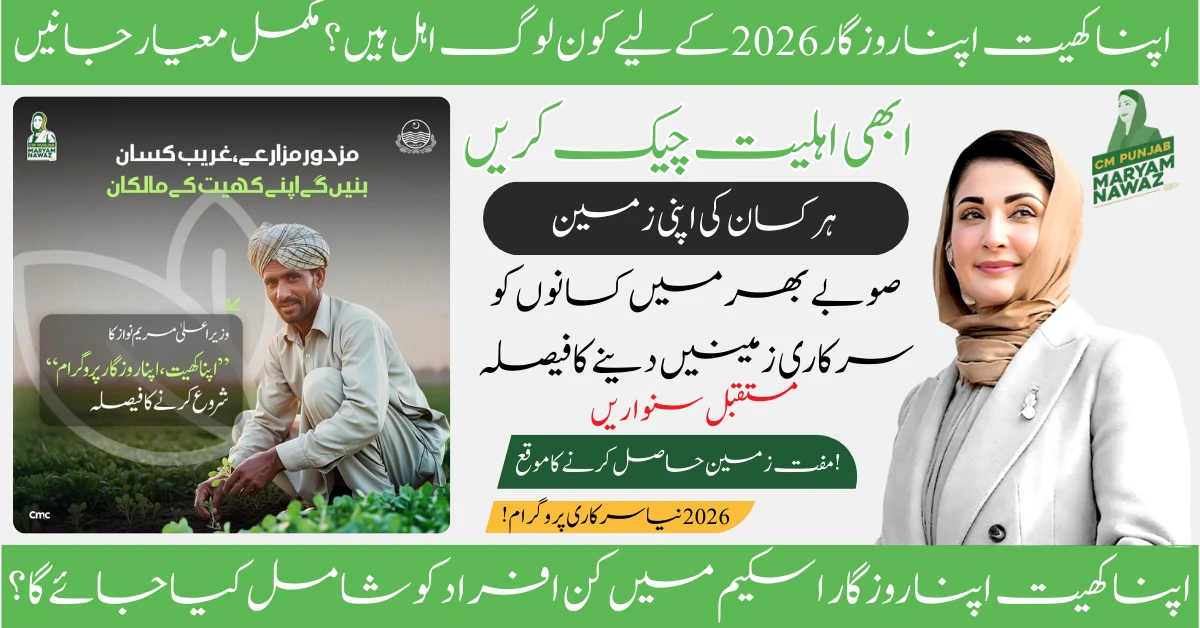
If you are wondering “Who is eligible for Apna Khet Apna Rozgar 2026?“, the answer is specific to the residents of Punjab. Eligible applicants must be between 18 and 35 years old, possess a valid CNIC and Punjab Domicile, and be either landless or a small farmer owning less than 5 acres. The scheme prioritizes unemployed youth with a background or interest in agriculture, offering them interest-free loans, machinery, and even land allotments to boost self-employment.
Introduction to Apna Khet Apna Rozgar 2026
The agricultural sector is the backbone of Pakistan’s economy. However, rising inflation and lack of resources have pushed young farmers away from this field. To counter this, the Chief Minister of Punjab has launched the revolutionary “Apna Khet Apna Rozgar” (My Farm, My Employment) initiative.
This program is not just about giving loans; it is a holistic roadmap for 2026. It aims to transform landless laborers into landowners and traditional farmers into agri-entrepreneurs. By providing free state land, subsidized machinery, and technical training, the government hopes to usher in a “Green Revolution 2.0”.
Why is 2026 the target year? The government has set a long-term vision to stabilize the agricultural economy by 2026. This scheme is part of a 5-year master plan to reduce unemployment and increase crop yield through modern high-tech farming.
Detailed Eligibility Criteria for 2026
To ensure transparency, the Punjab Government has set strict eligibility rules. Understanding these criteria is the first step to securing your future. Who Is Eligible For Apna Khet Apna Rozgar 2026?.
1. Age Requirements
The scheme focuses on youth empowerment.
- Primary Age Group: 18 to 35 Years.
- Extended Group: Up to 55 years for applicants with extensive farming experience.
- Verification: Your age is calculated based on the date of birth on your CNIC.
2. Residency and Domicile
This is a provincial scheme, not a federal one.
- Requirement: You must be a permanent resident of Punjab.
- Proof: A valid Domicile Certificate is mandatory.
- Excluded: Residents of Sindh, KPK, and Balochistan are not eligible for this specific quota.
3. Land Ownership Status
This is the most critical factor. The scheme is divided into two categories:
- Category A (Landless): Individuals who own zero acres of land. They are eligible for the “Land Allotment” phase.
- Category B (Small Farmers): Individuals who own less than 5 to 12.5 acres (varies by district). They are eligible for the “Machinery and Loan” phase.
4. Educational & Professional Background
While no degree is strictly required, preference is given to certain groups.
- Graduates: Agricultural graduates (B.Sc Hons) get extra points.
- Experience: Youth with a family background in farming are preferred.
- Status: You must not be a defaulter of any bank or financial institution.
| Criteria | Requirement | Priority Given To |
|---|---|---|
| Age | 18 – 35 Years | Unemployed Youth |
| Location | Punjab Province | Rural Residents |
| Land | 0 – 5 Acres | Landless Laborers |
| Clean Record | No Bank Default | Active Filers |
Benefits of The Scheme
The “Apna Khet Apna Rozgar 2026” is more than just a loan scheme. It is a comprehensive package designed to make farming profitable.
1. Free Land Allotment (Conditional)
The biggest attraction is the distribution of state, barren land.
- Offer: 3 to 5 acres of government land.
- Condition: The land is given on a lease for 3 to 5 years.
- Ownership: If the farmer successfully cultivates the barren land, the lease can be extended or converted to ownership rights in the future.
2. Interest-Free Loans
Start-up capital is the biggest hurdle for new farmers.
- Amount: Up to Rs. 50,000 for inputs (seeds, sprays).
- Machinery Loans: Larger amounts (up to 5 Lakhs) for buying equipment.
- Markup: 0% Interest (Interest-Free).
3. Subsidized Machinery
Modern farming requires modern tools.
- Tractors: Available at 50% subsidy.
- Harvesters: Linked with the “High-Tech Mechanization” program.
- Solar Tubewells: Huge discounts to reduce electricity costs.
4. The Kisan Card Integration
All benefits are routed through the Nawaz Sharif Kisan Card.
- This digital card ensures the money goes directly to the farmer.
- It protects you from middleman corruption.
- It can be used to buy fertilizer directly from authorized dealers.
Step-by-Step Application Process
The application process has been simplified for 2026. You can apply from the comfort of your home or visit a center.
Method 1: The Online Portal
This is the fastest way to apply.
- Visit the Website: Go to the official agripunjab.gov.pk portal.
- Registration: Click on the “Kisan Registration” tab.
- Data Entry: Enter your 13-digit CNIC number.
- Form Filling: Complete the online form with personal and land details.
- Uploads: Scan and upload your specific documents (Fard, Photo, CNIC).
- Submission: Click submit and save your “Application ID”.
Method 2: Manual Submission
For those with no internet access in rural areas.
- Visit Office: Go to the office of the Deputy Director Agriculture (Extension) in your Tehsil.
- Get Form: Request the “Apna Khet Apna Rozgar” application form.
- Fill & Attach: Fill it out and attach photocopies of your documents.
- Receipt: Submit it to the desk officer and get a stamped receiving slip.
The Verification Process
Once you submit, the real work begins on the government’s side.
- Digital Check: NADRA verifies your ID and Family tree.
- Physical Check: The local Patwari verifies your land status.
- Interview: You may be called for a short interview to assess your farming plan.
- Approval: Successful candidates receive an SMS from 8070.
Required Documents Checklist
Preparing your documents beforehand ensures a 100% success rate. Missing figures or blurred copies are the top reasons for rejection.
Primary Documents:
- Original CNIC: Must be valid (not expired).
- Domicile Certificate: Proof of Punjab residency.
- Passport Size Photos: 2 recent blue-background photos.
- Academic Certificates: Metric/Intermediate or Degree copies.
Land & Technical Documents:
- Fard / Jamabandi: Latest copy issued by the Land Record Center (Arazi Center).
- Affidavit: A stamp paper declaring you are landless (for Category A).
- Business Plan: A simple 1-page paper writing what you plan to grow (e.g., “I will grow Tunnel Vegetables”).
- No Objection Certificate (NOC): From your bank stating you have no pending loans.
Understanding The “Conditional Allotment”
Many users are confused about the “Free Land” aspect. Let’s clarify what conditional allotment implies for the 2026 vision.
It is not a gift; it is a responsibility. The government gives you barren (Banjar) state land. Your job is to make it fertile using the loan money provided.
- Year 1: You clear and level the land.
- Year 2: You start cultivation.
- Year 3: The government inspects the yield.
If you fail to cultivate it, the land is taken back. This ensures that only serious farmers get the benefit, helping the national economy.
The Role of Solar Tubewells
Energy crisis is a major issue for farmers. To make your “Apna Khet” profitable, you need cheap water. This scheme is directly linked to the Solar Tubewell Subsidy.
The Offer:
- The government pays 75% of the cost of the solar system.
- You pay only 25% upfront.
- This effectively makes electricity free for the next 20 years. Tip: When applying for the scheme, check the box for “Solar Assistance” to avail this.
Why Technical Training is Mandatory
In the past, loans were wasted because youth didn’t know modern farming. Under the 2026 roadmap, training is compulsory.
Training Modules:
- Tunnel Farming: How to grow vegetables off-season for high profit.
- Drip Irrigation: Saving water while increasing yield.
- Market Linkages: How to sell your produce directly to superstores, bypassing the Mandi agents.
The training is provided free of cost at various Adaptive Research Farms across Punjab.
Comparison With Other Schemes
How does “Apna Khet Apna Rozgar” differ from other initiatives?
| Feature | Prime Minister Kamyab Jawan | Apna Khet Apna Rozgar |
|---|---|---|
| Focus | General Business | Purely Agriculture |
| Land | No Land Given | Free Land Allotment |
| Interest | Low Interest (3-5%) | 0% Interest |
| Target | All Youth | Rural Farming Youth |
| Grant | Cash Only | Cash + Machinery + Land |
As you can see, for a farmer, this scheme is far superior.
Tips for a Successful Application
Competition is high. Millions will apply. Here is how to make your application stand out.
1. Be Specific in Your Plan: Don’t just say “I will farm.” Say “I will cultivate high-yield hybrid garlic on 3 acres using drip irrigation.” Specific plans show the government you are serious.
2. Update Your NADRA Record: Ensure your permanent address on your CNIC matches your district. If you live in Lahore but your ID says Multan, apply in Multan.
3. Clear Bank History: If you have a credit card or a previous bike loan, clear any late payments. A “Red Spot” on your credit report is an automatic rejection.
4. Apply Early: Funds are limited. Applications are usually processed on a “First Come, First Served” basis. Do not wait for the last date.
Frequently Asked Questions (FAQs)
Q1: Can women apply for Apna Khet Apna Rozgar? Yes. In fact, there is a 25% allocated quota specifically for women. The government encourages female agri-entrepreneurs to apply, especially for livestock and tunnel farming projects.
Q2: I am a student. Can I apply? Yes, provided you are over 18. However, you must prove that you have the time to manage the farming project. Being a full-time student might affect your “Physical Verification” score.
Q3: Is the land given permanently? Initially, no. It is a long-term lease (usually 5 to 10 years). However, historical data shows that successful tenants often get ownership rights (Malkiyat) after proving the land’s productivity over several years.
Q4: Can I apply if I already have a Kamyab Jawan loan? Generally, you cannot have two subsidized government loans active at the same time. You must clear the previous one before applying for this new interest-free facility.
Q5: What crops should I grow? The scheme encourages “High-Value Crops”. Focus on:
- Oilseeds (Canola, Sunflower).
- Vegetables (Tomatoes, Capsicum).
- Orchards (Citrus, Olives in Potohar region). Traditional wheat/rice farming is less prioritized for new allotments.
Q6: How long does the approval take? After the application deadline, the scrutiny takes about 30 to 45 days. You can check your status online using your application ID.
Q7: Is there an application fee? No. The application form and the online registration are 100% Free. Beware of agents asking for money to “submit” your form.
Conclusion
The “Apna Khet Apna Rozgar 2026” scheme is a golden opportunity. It answers the burning question, “Who is eligible for Apna Khet Apna Rozgar 2026?” with a broad, inclusive hand, welcoming the youth of Punjab to take charge of their food security.
For a young person sitting idle or stuck in low-paying jobs, this is a path to dignity and ownership. You are getting the three most expensive things in farming—Land, Capital, and Water—almost for free.
Your Action Plan:
- Check your CNIC expiry today.
- Visit the Arazi center if you own land to get your Fard.
- If landless, get your affidavit ready.
- Watch the portal for the opening date and apply within the first week.
Do not let this chance slip away. The future of Punjab is green, and you can be the one leading it. Apply now and claim your share of prosperity!