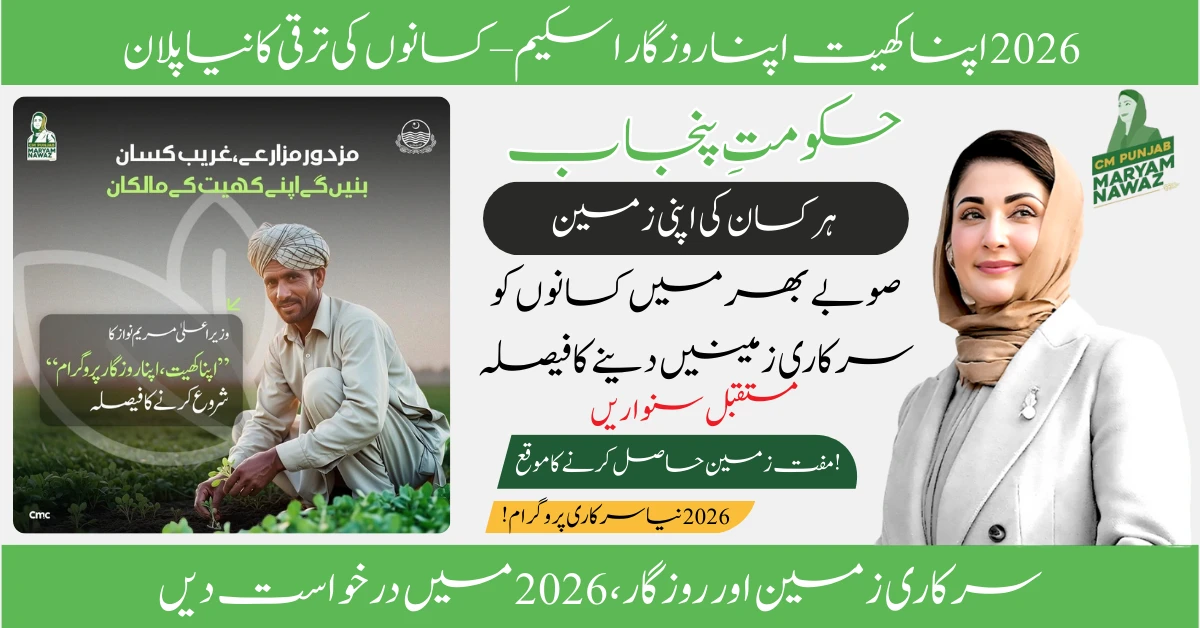
“Is Apna Khet Apna Rozgar Scheme 2026 registration open?” — you’ve found the most comprehensive and up-to-date guide available. This revolutionary agricultural employment program was officially announced by Punjab Chief Minister Maryam Nawaz on January 24, 2026, and has generated massive interest across the province.
The straightforward answer is: The Apna Khet Apna Rozgar registration portal is not yet live, but the scheme is officially approved and implementation has been ordered immediately. The Punjab Cabinet has directed relevant departments to provide government agricultural land to 50,000 individuals in the first phase, with registration expected to open in late January or early February 2026.
What Exactly Is the Apna Khet Apna Rozgar Scheme 2026?
The Apna Khet Apna Rozgar Scheme 2026 Registration Open? Apna Khet Apna Rozgar Programme (translating to “Your Field, Your Employment”) is a flagship agricultural empowerment initiative launched by the Government of Punjab under CM Maryam Nawaz Sharif. Unlike loan-based schemes, this program directly allocates government-owned agricultural land to eligible beneficiaries for cultivation.
Core Objectives of the Scheme
The program was approved during the historic 32nd Punjab Cabinet meeting on January 24, 2026, with several transformative goals:
- Combat Rural Unemployment: Provide sustainable livelihoods to landless laborers and unemployed youth through agriculture
- Boost Agricultural Production: Bring unused and underutilized state farmland into productive cultivation
- Promote Food Security: Increase crop yields and strengthen Punjab’s agricultural backbone
- Encourage Youth in Farming: Make agriculture an attractive and viable career option for educated youth
- Rural Economic Development: Create ripple effects through increased spending, livestock activities, and local agribusiness
How It’s Different from CM Punjab Rozgar Scheme
Many people are confusing Apna Khet Apna Rozgar with the existing CM Punjab Rozgar Scheme. Here’s the critical difference:
| Feature | Apna Khet Apna Rozgar (Agricultural Land) | CM Punjab Rozgar Scheme (Business Loans) |
|---|---|---|
| Primary Benefit | Direct allocation of government farmland | Interest-free/subsidized business loans |
| Target Group | Landless farmers, agricultural laborers, rural youth | Entrepreneurs, graduates, small business owners |
| Amount/Asset | Physical agricultural land for cultivation | Cash loans from Rs. 100,000 to Rs. 10 million |
| Repayment | No repayment — land use on long-term lease basis | Loan must be repaid over 2-5 years |
| Portal | Not yet launched (expected soon at Punjab.gov.pk) | Active at rozgar.psic.punjab.gov.pk |
| Focus Area | Agriculture and farming sector only | Any type of business or enterprise |
| Announced | January 24, 2026 | Active since 2024, relaunched 2026 |
This distinction is crucial because dozens of blogs are incorrectly mixing these two completely separate programs.
Current Registration Status: Is the Portal Open?
As of January 31, 2026, here is the verified status of Apna Khet Apna Rozgar registration:
Official Status Update
Registration Portal: ❌ Not Yet Live Scheme Approval: ✅ Officially Approved by Punjab Cabinet (Jan 24, 2026) Implementation Directive: ✅ Immediate implementation ordered Expected Portal Launch: 🕐 Late January to Mid-February 2026
What the Punjab Government Has Confirmed
According to official sources from the 32nd Punjab Cabinet meeting:
- 50,000 beneficiaries will receive government farmland in Phase 1
- Immediate steps have been directed for swift implementation
- Departments including Agriculture, Revenue, and Land Administration have been tasked with preparing the allocation framework
- The program will utilize unused and underutilized state agricultural land across Punjab
Why the Portal Isn’t Live Yet
The registration portal has not launched because:
- Land Survey Ongoing: Government departments are identifying and surveying available agricultural land across districts
- Eligibility Framework: Detailed criteria and point system for beneficiary selection are being finalized
- IT System Development: The online registration portal infrastructure is under development
- Anti-Fraud Mechanisms: Biometric verification and NADRA integration systems are being implemented
- District-Wise Allocation: Determining how many beneficiaries each district will receive based on available land
Where and How to Register: Step-by-Step Guide (When Portal Opens)
While the portal isn’t live yet, based on the government’s track record with similar schemes (Apni Chhat Apna Ghar, Apni Zameen Apna Ghar, CM Punjab Rozgar), here’s what the registration process will most likely involve:
Expected Registration Methods
Method 1: Online Registration (Primary)
The Punjab government will most likely launch a dedicated web portal, expected at:
- Primary URL: apnakhetapnarozgar.punjab.gov.pk (tentative)
- Alternative: Registration section on Punjab.gov.pk
- Mobile Access: Portal will be mobile-friendly for phone/tablet registration
Method 2: District Agriculture Office Registration
For citizens without internet access:
- Visit your District Agriculture Office or Tehsil Municipal Office
- Dedicated registration counters will be established
- Staff will assist with online form filling
Method 3: Mobile Registration Vans (Rural Areas)
For remote villages:
- Government may deploy mobile registration camps
- Similar to BISP NSER dynamic survey approach
- Schedule will be announced district-wise
Step-by-Step Application Process (Projected)
Based on similar Punjab government schemes, here’s the likely registration flow:
Step 1: Portal Access
- Visit the official Apna Khet Apna Rozgar portal when announced
- Click “New Registration” or “Apply Now”
Step 2: CNIC Verification
- Enter your 13-digit CNIC number
- NADRA verification will confirm your identity
- Mobile number registered with your CNIC will receive OTP
Step 3: Personal Information
- Full name (as per CNIC)
- Father’s/Guardian’s name
- Date of birth
- Current residential address
- District and Tehsil
- Contact details (mobile, email)
Step 4: Eligibility Questions
- Current land ownership status
- Monthly household income
- Education level
- Agricultural experience
- Family size and dependents
Step 5: Document Upload Required documents will likely include:
- Valid CNIC (front and back)
- Punjab domicile certificate
- Proof of landless status (affidavit or revenue record)
- Bank account details (IBAN)
- Recent passport photographs
- Income certificate (if required)
Step 6: Submit and Track
- Review all information carefully
- Accept terms and conditions
- Submit application
- Save your Tracking ID/Token Number
- Track status via SMS or portal login
Complete Eligibility Criteria: Do You Qualify?
While official eligibility hasn’t been published yet, based on the scheme’s objectives and similar agricultural programs, here are the expected qualification requirements:
Primary Eligibility Requirements
1. Residency & Domicile
- Must be a permanent resident of Punjab
- Valid Punjab domicile certificate required
- CNIC address should match domicile
2. Landless or Minimal Land Ownership
- Priority: Individuals owning zero agricultural land
- May Qualify: Owners of less than 2 acres (considered marginal farmers)
- Excluded: Those owning 5+ acres or substantial agricultural property
3. Age Bracket
- Expected range: 18 to 50 years
- Emphasis on youth (18-35) for agricultural revitalization
- Elderly applicants may qualify if physically fit for farming
4. Agricultural Background
- Priority given to:
- Agricultural day laborers (haris/kammi)
- Families with farming background but no land
- Agriculture diploma/degree holders
- Youth willing to pursue farming as career
5. Income Threshold
- Monthly household income likely below Rs. 50,000-60,000
- Poverty score (similar to BISP PMT) may be considered
- Assessed through income certificate or NSER data
6. Pakistan Citizenship
- Must be a Pakistani national
- Valid CNIC required (expired CNICs not accepted)
Priority Categories (Who Gets Selected First)
Based on cabinet objectives, these groups will receive preference:
- Landless Agricultural Laborers — People currently working on others’ farms for daily wages
- Educated Rural Youth — Agriculture graduates or diploma holders
- Women Farmers — Female heads of households interested in farming
- Widows and Orphans — Families with no male breadwinner
- Persons with Disabilities — PWDs capable of managing or overseeing farmland
- South Punjab Residents — Special quota for historically underdeveloped districts
- Flood/Disaster Affected Families — Recent calamity survivors
Exclusion Criteria
You will NOT be eligible if:
❌ You already own substantial agricultural land (likely >5 acres) ❌ You have a government job (BPS-16 or above) ❌ You own commercial property or run a profitable business ❌ You’re living permanently abroad (NRPs not eligible) ❌ You have been convicted of land fraud or agricultural crimes ❌ You’re receiving another government agricultural subsidy that conflicts with this scheme
How Will Land Allocation Actually Work?
The most common question people ask is: “Will I get permanent ownership or just temporary use?” Here’s what to expect based on similar government land allocation programs:
Expected Land Allocation Model
Type of Rights: Most likely long-term lease (5-10 years, renewable), not permanent ownership
Land Size Per Beneficiary:
- Expected: 2-5 acres per family
- Varies based on district availability
- Marginal/small holdings prioritized over large allotments
Location of Land:
- District-based allocation — you’ll get land in your home district or nearby
- Unused government land identified by Revenue Department
- Land may be in rural/semi-rural areas with irrigation access
Conditions of Use
Beneficiaries will likely have to:
✅ Cultivate the land actively — leaving it barren may result in cancellation ✅ Grow approved crops — guidance from Agriculture Extension Department ✅ Not sell or transfer — land remains government property ✅ Allow monitoring — periodic inspections by agriculture officers ✅ Report yields — data collection for program assessment
Potential for Ownership: After 5-10 years of successful cultivation, beneficiaries may earn the right to purchase the land at subsidized rates or convert lease to ownership.
Additional Support Beyond Land
The scheme is expected to provide more than just land:
- Seed and Fertilizer Subsidy — Connection to Kisan Card Program
- Agricultural Training — Modern farming techniques through extension officers
- Irrigation Support — Access to canal water or tube well sharing
- Market Linkages — Help selling crops through government procurement centers
- Credit Access — Linkage to agricultural loans for equipment
- Crop Insurance — Protection against natural disasters
Fake Websites and Scams: How to Protect Yourself
Within days of the scheme’s announcement, dozens of fake websites have already appeared online claiming to offer registration. Here’s how to protect yourself:
Red Flags of Scam Websites
🚩 Charging registration fees — All government schemes are 100% free to apply 🚩 URLs ending in .com or .pk — Real government portals end in .gov.pk 🚩 Promising “guaranteed selection” — No one can guarantee approval 🚩 Asking for bank passwords or ATM PINs — Government never requests this 🚩 Operating through WhatsApp groups — Official communication is via SMS and portal 🚩 Demanding advance payment — No legitimate portal asks for money upfront 🚩 Extremely poor Urdu/English — Official sites have professional content 🚩 No contact information — Real portals list helplines and office addresses
Verified Official Sources Only
Legitimate Information Channels:
- Main Portal: Punjab.gov.pk
- Agriculture Department: www.agripunjab.gov.pk
- CM Office: cmpunjab.gov.pk
- Official Social Media: CM Punjab verified accounts on Twitter/X and Facebook
How to Verify a Website: ✅ URL must end in .gov.pk ✅ Has HTTPS security (lock icon in browser) ✅ Lists verifiable government contact numbers ✅ Contains official Punjab government logos and branding ✅ No payment gateway or money transfer options
Report Scams
If you encounter fake websites:
- Do not provide any personal information
- Take screenshots as evidence
- Report to FIA Cyber Crime Wing: Call 1991 or visit complaint.fia.gov.pk
- Report to Punjab IT Board: pitb.gov.pk
Expected Timeline: When Will Everything Happen?
Based on similar Punjab government scheme rollouts, here’s a realistic timeline:
| Phase | Expected Timeframe | What Happens |
|---|---|---|
| Cabinet Approval | ✅ January 24, 2026 (Done) | Official decision and budget allocation |
| Land Survey & Identification | Late January – February 2026 | Revenue/Agriculture departments identify available land |
| Registration Portal Development | February 2026 | IT infrastructure and online portal built |
| Portal Launch | Mid-February to Early March 2026 | Online registration opens to public |
| Application Period | 30-60 days from portal launch | Citizens apply online or at district offices |
| Verification & Scrutiny | March-April 2026 | NADRA verification, field visits, committee review |
| Beneficiary Selection | April-May 2026 | Computerized balloting or merit-based selection |
| Land Allotment | May-June 2026 | Physical handover of land to selected beneficiaries |
| Agricultural Support Begins | June 2026 onwards | Training, seeds, technical assistance provided |
Important: These are educated projections based on past schemes. Official timelines will be announced by the Punjab government.
What Documents Should You Prepare Now?
Even though registration isn’t open yet, you can start gathering required documents to avoid last-minute hassles:
Essential Documents Checklist
Identity Documents: ✅ Original valid CNIC (must not be expired) ✅ Punjab domicile certificate (original or attested copy) ✅ Recent passport-size photographs (white background)
Residency Proof: ✅ Utility bill (electricity, gas, or water — within last 3 months) ✅ Rent agreement or property ownership documents ✅ Union Council verification letter (if available)
Income & Employment: ✅ Income certificate from Tehsil office (showing low income) ✅ Employment status — if daily wage laborer, statement from employer ✅ BISP/NSER registration (if applicable — shows economic vulnerability)
Agricultural Background: ✅ Agriculture education certificates (if you have diploma/degree) ✅ Farming experience statement (affidavit on stamp paper) ✅ Land ownership proof showing zero/minimal holdings (revenue record)
Banking: ✅ Bank account in your own name (for future assistance disbursement) ✅ IBAN number (get from bank statement)
Special Category: ✅ Widow: Husband’s death certificate ✅ Disabled: Disability certificate from DHQ hospital ✅ Flood-affected: NDMA or PDMA issued certificate
How to Track Application Status (Once Submitted)
When registration opens and you apply, tracking will likely work through:
Portal Login Tracking
- Log in to the Apna Khet Apna Rozgar portal with your CNIC
- View application status dashboard
- Possible statuses:
- Submitted — Application received
- Under Verification — Documents being checked
- Field Inspection Scheduled — Officer will visit your area
- Shortlisted — You’ve passed initial screening
- Selected — Congratulations! You’ve been chosen
- Rejected — Application did not meet criteria (reason stated)
SMS Tracking
- Track via SMS by sending your Tracking ID/CNIC to designated number
- Receive automated updates at key milestones
Helpline Support
- Call the official helpline (will be announced with portal)
- Provide your CNIC and token number
- Get status update from customer service