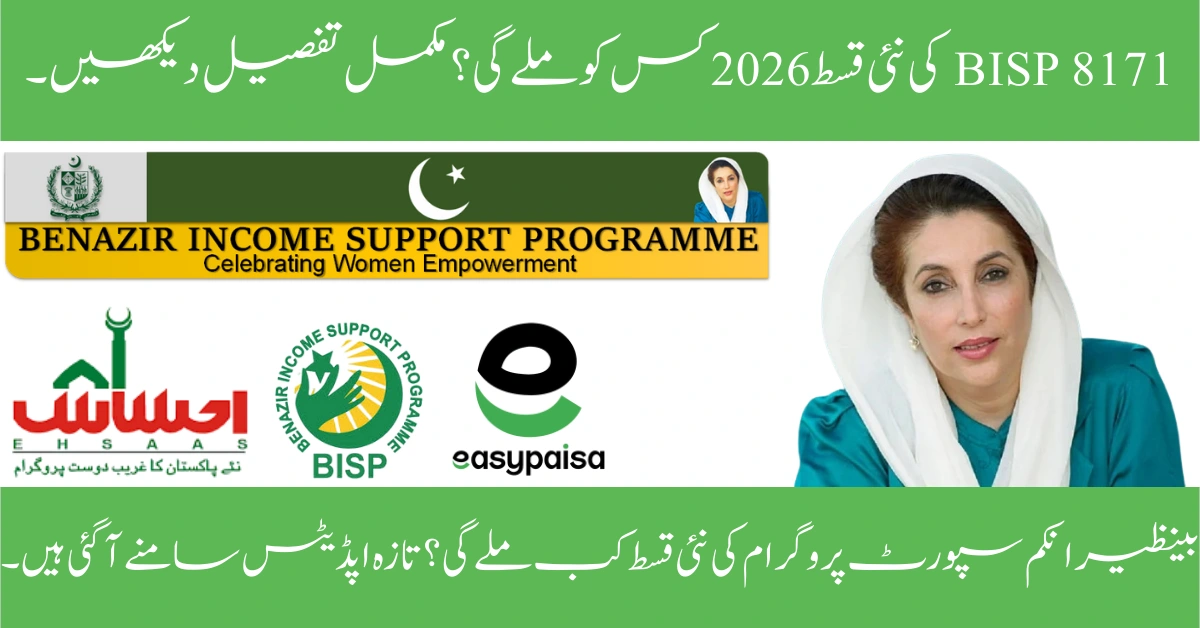
Are you a BISP beneficiary in Pakistan wondering about the latest bisp 8171 payment update 2026? With inflation on the rise and economic pressures mounting, timely financial support from the Benazir Income Support Programme (BISP) is more crucial than ever. In this comprehensive guide, we’ll cover everything you need to know about the 2026 payment changes, including increased installment amounts, new digital withdrawal options, detailed schedules, eligibility checks, and troubleshooting tips. By the end, you’ll have all the tools to access your funds seamlessly—no more confusion or delays. Let’s dive in. CM Punjab Parwaz Card Registration Online Apply
What Is the Benazir Income Support Programme (BISP)?
The Benazir Income Support Programme, launched in 2008 and named after former Prime Minister Benazir Bhutto, is Pakistan’s flagship social safety net initiative. It aims to provide unconditional cash transfers to the poorest households, primarily targeting women to empower them financially and reduce poverty. Over the years, BISP has evolved from a simple cash handout to a multifaceted program integrating education, health, and skill development incentives.
In 2026, BISP continues to serve over 9 million families, with a focus on digital transformation to make payments more accessible. The program is closely linked to the Ehsaas framework, which emphasizes transparency and inclusivity. If you’re new to BISP, understanding its core components is key to navigating updates like the bisp 8171 payment update 2026.
- Key Objectives: Poverty alleviation, gender equality, and human capital development.
- Funding: Primarily government-backed, with support from international partners like the World Bank.
- Impact So Far: Since inception, BISP has disbursed billions in aid, lifting millions out of extreme poverty and improving school enrollment rates among beneficiary children.
Understanding the 8171 Service: Your Gateway to BISP Payments
The 8171 short code is the official SMS and helpline service for BISP, making it easy for beneficiaries to check eligibility, payment status, and more without visiting offices. Introduced under the Ehsaas Emergency Cash program during the COVID-19 pandemic, it has become a staple for quick queries.
In 2026, 8171 has been upgraded with better integration for real-time updates. Here’s how it works:
- SMS Check: Send your CNIC number (without dashes) to 8171. You’ll receive an instant response on your eligibility or payment details.
- Helpline Support: Call 8171 for voice assistance, available in Urdu and regional languages.
- Web Portal Integration: Visit the official 8171.bisp.gov.pk portal to enter your CNIC and CAPTCHA for detailed status.
This service is free and secure, but always verify messages—official ones come from “8171” only. Avoid scams by ignoring unsolicited calls asking for personal info.
Major Changes in BISP Payments for 2026
The bisp 8171 payment update 2026 brings several enhancements to address beneficiary feedback and economic challenges. Based on official announcements from the BISP website and government statements, payments have been adjusted for inflation, with a focus on faster disbursements and digital options. Here’s what’s new:
Increased Payment Amounts
To combat rising living costs, the quarterly installment has been raised. In 2025, it was around PKR 10,500–12,000, but for 2026:
- Standard Kafalat Installment: PKR 14,500 per quarter for eligible families.
- Additional Incentives: Up to PKR 2,000 extra for households meeting conditional requirements, like child vaccination or school attendance.
- Special Provisions: Women-headed households and those in disaster-prone areas may receive one-time bonuses of PKR 5,000–10,000.
These increases aim to cover essentials like food, utilities, and education, benefiting over 9 million families nationwide.
New Payment Withdrawal Methods
Gone are the days of long queues at campsites. The 2026 updates emphasize digital inclusion:
- SIM Wallet System: Link your registered mobile number to a digital wallet (e.g., via JazzCash or EasyPaisa) for direct transfers. Withdraw from any ATM or agent.
- ATM Card Withdrawals: Eligible beneficiaries receive BISP-branded debit cards for fee-free withdrawals at partnered banks like HBL, UBL, and National Bank.
- Bank Transfers: For those with accounts, funds are directly deposited—check via online banking apps.
- Rashan Subsidy Integration: Use payments for subsidized groceries at utility stores, with digital tracking.
These methods reduce corruption and ensure funds reach you faster, especially in rural Punjab, Sindh, and Khyber Pakhtunkhwa.
Phased Rollout and District-Wise Implementation
Payments are released in phases to manage logistics, starting with high-poverty districts. This prevents system overloads and ensures smooth distribution.
BISP Payment Schedule 2026: Detailed Breakdown
Here’s a comprehensive table outlining the expected quarterly payment schedule for 2026, based on official patterns and recent announcements. Note that exact dates may vary slightly due to holidays or verifications—always check via 8171 for personalized updates.
| Quarter | Start Date | End Date | Estimated Amount (PKR) | Key Districts in Phase 1 | Withdrawal Methods Available |
|---|---|---|---|---|---|
| Q1 (Jan-Mar) | January 10, 2026 | January 31, 2026 | 14,500 + incentives | Lahore, Karachi, Peshawar, Quetta, Multan | SIM Wallet, ATM, Bank Transfer |
| Q2 (Apr-Jun) | April 10, 2026 | April 30, 2026 | 14,500 (possible inflation adjustment) | Faisalabad, Rawalpindi, Hyderabad, Sukkur, Bahawalpur | All methods + Rashan Subsidy |
| Q3 (Jul-Sep) | July 10, 2026 | July 31, 2026 | 14,500 + education bonus | Islamabad, Gujranwala, Sialkot, Abbottabad, Gwadar | Digital priority with mobile alerts |
| Q4 (Oct-Dec) | October 10, 2026 | October 31, 2026 | 14,500 + winter bonus (up to 2,000 extra) | Remaining rural districts in Punjab, Sindh, KP, Balochistan | Full options, including campsites for remote areas |
This schedule covers the Benazir Kafalat program primarily, with overlaps for other schemes like Taleem Razakar (education stipends). Phases typically last 2–3 weeks per district group, with SMS notifications sent 1–2 days in advance.
How to Check Your BISP Payment Status in 2026
Staying updated is simple with the bisp 8171 payment update 2026 tools. Follow these steps:
- Via SMS:
- Text your 13-digit CNIC to 8171.
- Response example: “Your payment of PKR 14,500 is ready for withdrawal from [date].”
- Online Portal:
- Go to 8171.bisp.gov.pk.
- Enter CNIC and CAPTCHA.
- View eligibility, payment history, and next due date.
- Mobile App (New in 2026):
- Download the official BISP app from Google Play or App Store.
- Log in with CNIC and OTP.
- Track real-time status and withdraw digitally.
- Helpline or Office Visit:
- Call 0800-26477 for support.
- Visit tehsil-level BISP offices if issues persist.
Pro Tip: Update your mobile number and CNIC details via NADRA to avoid holds.
Eligibility Criteria for BISP in 2026
Not everyone qualifies—BISP uses a poverty scorecard from the National Socio-Economic Registry (NSER). Key requirements:
- Household Income: Below PKR 30,000–40,000 monthly (varies by province).
- Poverty Score: Less than 32 on the NSER scale.
- Beneficiary Profile: Preference for female applicants, widows, orphans, or disabled family members.
- Exclusions: Government employees, landowners over 2 acres, or those with luxury assets.
To check: Use 8171 or the portal. If ineligible, appeal via BISP offices with proof of poverty.
How to Register for BISP in 2026
New registrations are ongoing through dynamic surveys:
- NSER Survey: Wait for door-to-door teams or visit BISP centers.
- Self-Registration: Use the portal or app to apply with CNIC, household details, and income proof.
- Verification: NADRA cross-checks data within 30 days.
- Approval: Receive confirmation SMS if selected.
Over 1 million new families are expected to join in 2026, focusing on underserved areas.
Common Issues and Solutions for BISP Payments
Facing delays? Here’s how to fix them:
- Issue: No SMS Received – Solution: Verify your number at a BISP center or via helpline.
- Issue: Payment Held Due to Verification – Solution: Renew CNIC and resubmit details online.
- Issue: Wrong Amount – Solution: Report via 8171; deductions are illegal.
- Issue: SIM Wallet Not Working – Solution: Contact your mobile provider or switch to ATM.
- Scam Alerts: Never share PINs or pay fees—report to PTA.
These tips can save you time and frustration.
Conclusion
The bisp 8171 payment update 2026 marks a positive step toward more efficient, inclusive support for Pakistan’s vulnerable populations. With increased amounts up to PKR 14,500, digital withdrawal options like SIM wallets and ATMs, and a clear quarterly schedule, beneficiaries can plan better for the year ahead. Remember to check your status regularly via 8171, keep your details updated, and report issues promptly. If you’re eligible, this program could be a lifeline—stay informed and empowered.