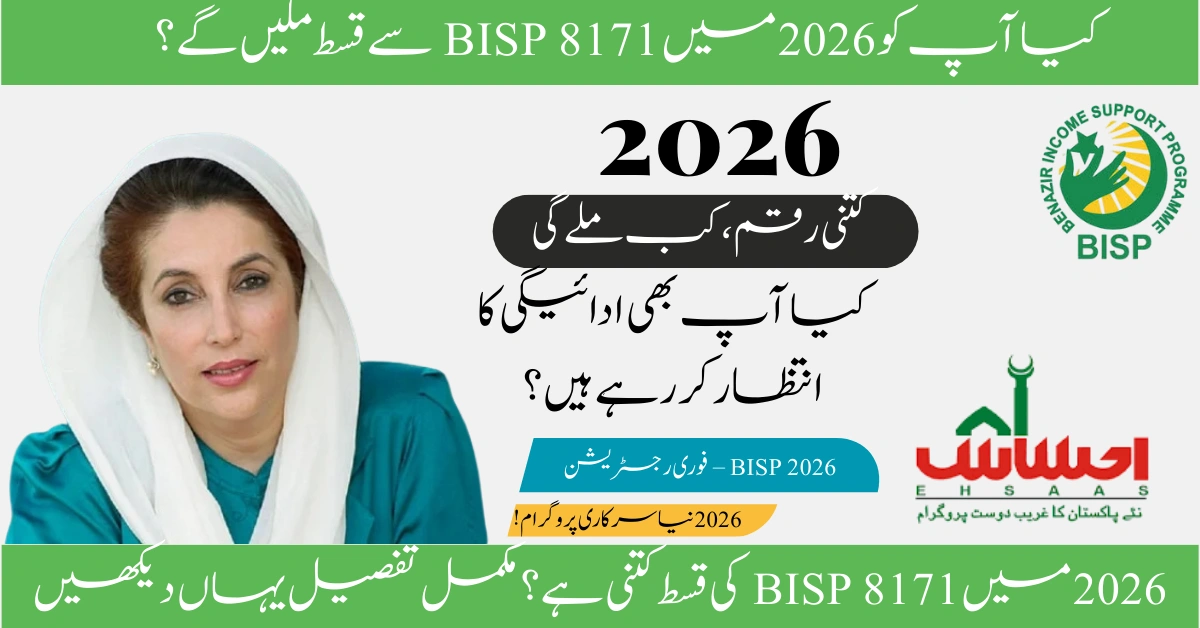
The BISP 8171 payment system represents Pakistan’s most important social welfare program designed to provide financial assistance to low-income families. If you’re searching for information about the How Much is BISP 8171 Payment in 2026?, your primary intent is to find the exact quarterly payment amount, understand eligibility requirements, and learn how to check payment status through official channels.
Users searching for “BISP 8171 payment 2026” want immediate, accurate information about the quarterly payment amount (Rs 13,500), how to verify eligibility, and the most efficient methods to check payment status online without visiting government offices. This comprehensive guide addresses all these critical concerns with verified information from official government sources.
BISP 8171 Payment Amount in 2026 – Exact Details
The current BISP 8171 quarterly payment amount for 2026 is exactly Rs 13,500 per installment. This represents a significant increase from previous years, reflecting the Government of Pakistan’s commitment to provide better financial relief to vulnerable families struggling with rising inflation and increased living costs. The quarterly payment system distributes assistance in four phases throughout the year to manage administrative workload and ensure smooth disbursement across all provinces.
How Much is BISP 8171 Payment in 2026? reaches beneficiaries in Punjab, Sindh, Khyber Pakhtunkhwa, Balochistan, Gilgit-Baltistan, and Azad Jammu & Kashmir through a systematic distribution process. Special relief packages may provide additional amounts beyond the standard Rs 13,500, particularly during Ramadan, Eid celebrations, and winter relief seasons.
Families that missed previous quarterly installments due to verification delays may qualify for double payments, receiving combined amounts of Rs 27,000 (two times Rs 13,500) once their documents are fully verified and updated in the NSER system. This government initiative specifically targets beneficiaries who faced unexpected delays beyond their control.
Understanding BISP Benazir Kafaalat Program – Payment Structure
| Payment Details | Information |
|---|---|
| Quarterly Amount | Rs 13,500 per quarter |
| Annual Total | Rs 54,000 (4 payments) |
| Official Program Name | Benazir Kafaalat Program |
| Total Beneficiaries | 9.3 to 10.2 million families |
| Payment Frequency | Every 3 months (Quarterly) |
| Payment Collection Methods | Cash, Bank ATM, Digital Wallet |
| Primary Eligibility | Monthly income under Rs 50,000 |
| Required Documentation | Valid, Active CNIC card |
| Biometric Verification | Mandatory for all payments |
The Benazir Kafaalat initiative operates as the Government’s primary cash assistance program, designed to distribute financial relief to deserving households across Pakistan. The quarterly payment structure ensures regular, predictable income for families planning household expenses, food purchases, healthcare needs, and educational costs. This systematic approach helps stabilize the financial situation of millions of households that depend entirely on this critical lifeline during economic uncertainty.
The BISP program has benefited over 10 million families since its inception, making it Pakistan’s largest social protection initiative. Each quarterly payment cycle involves biometric verification to prevent fraud and ensure only registered beneficiaries receive assistance. The program’s transparent design eliminates middlemen, agent deductions, and unauthorized charges.
Who is Eligible for BISP 8171 Payment in 2026?
Before checking your BISP 8171 payment status, you must meet specific eligibility criteria set by the Government. These requirements ensure that assistance reaches the genuinely deserving families and prevents misuse of public funds. The primary eligibility conditions include:
- Monthly household income below Rs 50,000
- Valid active Pakistani CNIC card (not expired)
- No family member employed in government service
- Absence of major valuable assets such as land or property
- Registration in the NSER database (National Socio-Economic Registry)
Your Proxy Means Test (PMT) score must be less than 32 to qualify for the BISP 8171 payment. The NSER database maintains your complete household information, including family size, income sources, living conditions, and asset details. If your PMT score is higher than the threshold, you can undergo a Dynamic Survey to update your information and potentially reduce your score for future eligibility.
This democratic approach ensures that families facing genuine financial hardship receive support regardless of their initial registration status. The BISP system regularly updates household information to ensure accurate eligibility assessments. Beneficiaries can request re-surveys if their economic conditions have changed significantly since their last verification.
How to Check Your BISP 8171 Payment Status in 2026 – Step-by-Step Guide
Online Portal Method (Fastest & Most Reliable Way)
The official 8171.bisp.gov.pk portal offers the fastest way to check payment status anytime, anywhere from your smartphone or computer. Here’s the step-by-step process:
- Visit 8171.bisp.gov.pk in your web browser
- Look for the “Check Eligibility” button on the homepage
- Enter your complete 13-digit CNIC number without dashes
- Type the captcha code shown on screen to verify you’re human
- Click the Submit button and wait for results
The system displays whether your payment is approved, pending, or requires re-verification within seconds. You’ll see your current eligibility status, any pending verification requirements, and the exact date when your payment will be released. The portal now supports multiple languages including Urdu, Sindhi, and Pashto, making it accessible to all beneficiaries regardless of their language preference.
SMS Service Method (For Those Without Internet)
Send your 13-digit CNIC number to 8171 from any mobile phone and receive automatic payment status information instantly. This service works on all major networks including:
- Jazz
- Zong
- Ufone
- Telenor
Ensure that your SIM card is registered under your own CNIC number for accurate responses from the BISP system. The SMS method requires no internet connection and is completely free, making it ideal for families in rural or underdeveloped areas without consistent smartphone access. You’ll receive your eligibility status, payment approval date, and next collection date via SMS within minutes.
Visiting BISP Tehsil Offices for Personal Assistance
Over 600 BISP Tehsil Offices operate throughout Pakistan where trained staff can check your status manually and resolve any issues preventing payment release. Bring your original CNIC and any supporting documents related to your household. The office staff will verify your information in the NSER database and explain any problems preventing payment distribution.
This method takes longer than online options but provides personalized assistance for complex eligibility issues, biometric problems, or payment blocking. Staff can also help you update household information, register mobile numbers, and resubmit documents if previous submissions were incomplete or rejected.
BISP 8171 Payment Methods in 2026 – How to Collect Your Payment
The government has modernized payment distribution to eliminate agent deductions and ensure beneficiaries receive their full payment amount. The available payment methods include:
Authorized Payment Centers – Visit any official BISP payment center with your CNIC and provide biometric verification (fingerprint matching). Staff will verify your identity and disburse Rs 13,500 in cash.
HBL ATMs and Bank Alfalah ATMs – Use any HBL Konnect ATM or Bank Alfalah ATM nationwide. Insert your BISP card, enter your PIN, and withdraw funds with biometric verification.
BISP Mobile Wallet – The BISP Wallet system represents the latest payment innovation, allowing direct fund transfers into secure digital wallets linked to your CNIC. This system completely removes the need for traditional cash disbursement centers and reduces fraud, delays, and complaints.
Once your wallet is activated through biometric verification at any BISP center, you can withdraw funds anytime from authorized agents without lengthy queues or waiting for specific payment dates.
Common Issues and Solutions for BISP 8171 Beneficiaries
Error 933 or “Dynamic Survey Required” Message
This message indicates that your household information needs updating in the NSER database. Visit your nearest BISP Tehsil Office with your CNIC and allow officers to conduct a fresh Dynamic Survey of your household conditions.
After updating your information, your payment is usually released in the next payment phase automatically. Do not pay anyone claiming they can “fix” this error—all BISP services are completely free with no hidden charges. The entire process takes 10-15 minutes and solves the problem permanently.
Biometric Verification Failure – Fingerprint Issues
Fingerprint mismatch occurs when your current fingerprints don’t match records from your original CNIC registration. This commonly happens due to:
- Advanced age affecting fingerprint patterns
- Manual work causing finger damage
- Skin conditions like eczema or psoriasis
- Recent injuries to hands or fingers
Visit the nearest NADRA office to update your biometric data, which will then sync with BISP systems automatically. Once updated, your next payment withdrawal will process smoothly without issues or delays.
Payment Blocked or Pending Status – How to Resolve
Several reasons can cause payment blocking including:
- Incomplete household verification
- Outstanding verification flags in the system
- Inactive CNIC (expired identity card)
- Unregistered mobile number with NADRA
- Duplicate registrations in the NSER database
Check that your CNIC is valid and not expired, your phone number is registered with NADRA under your CNIC, and all survey data is current. If problems persist, contact the BISP helpline at 0800-26477 for immediate assistance from trained customer service representatives. The helpline operates 24/7 and provides support in multiple languages.
BISP 8171 Double Payment 2026 Update – Get Two Installments
Families who missed previous quarterly installments due to verification delays now qualify for double payment relief. Double payment means receiving two combined quarterly amounts (Rs 27,000) instead of single installments once your documents are completely verified and updated in the system.
This government initiative specifically targets beneficiaries who faced unexpected delays beyond their control due to:
- System verification glitches
- NADRA database synchronization issues
- Biometric authentication problems
- Weather-related distribution delays
- Natural disasters affecting payment cycles
To check if you qualify for double payment, log into the 8171 portal or send your CNIC via SMS to 8171. The system will explicitly indicate if you have pending double payment approval. According to official announcements, double payment distribution was scheduled between January and February 2026, though distribution continues through early 2026 depending on your specific province and registration phase.
Important Safety Tips for BISP 8171 Beneficiaries – Protect Yourself
Never share your complete CNIC details with unauthorized individuals or unofficial BISP pages on social media platforms. Always use the official portal at 8171.bisp.gov.pk or official SMS service for status checks. Always verify payment collection locations are authorized BISP centers, HBL Konnect outlets, or Bank Alfalah ATMs to avoid scams.
Keep your mobile number registered with NADRA and respond immediately to any SMS alerts from 8171 requesting re-verification or updated information. Failing to respond to official requests can result in temporary payment delays or eligibility suspension.
Maintain your CNIC in valid condition and update your household address if you relocate to ensure continued payment delivery. Never trust unofficial agents or websites claiming to speed up your payment—these are scams designed to extract money from vulnerable beneficiaries. The BISP program is completely free and requires no additional payments or fees from beneficiaries.
Payment Schedule and Distribution Timeline for 2026
The 2026 payment cycle begins in January and extends through December with quarterly distributions. Phase 1 initially covers smaller cities and rural areas, while Phase 2 includes major metropolitan areas including Karachi, Islamabad, Rawalpindi, and Faisalabad.
Distribution happens in waves to manage administrative load and prevent overwhelming payment centers with excessive beneficiary visits simultaneously. The government gradually rolled out BISP smart cards in 2026 allowing beneficiaries to withdraw funds anytime rather than waiting for specific payment dates. This flexibility enables families to manage household finances more effectively and respond to emergencies without waiting for official payment phases.
Distribution Timeline:
- Quarter 1 (Jan-Mar): Rs 13,500
- Quarter 2 (Apr-Jun): Rs 13,500
- Quarter 3 (Jul-Sep): Rs 13,500
- Quarter 4 (Oct-Dec): Rs 13,500
- Annual Total: Rs 54,000
Frequently Asked Questions
Conclusion
The BISP 8171 payment system in 2026 provides critical financial support to over 9 million Pakistani families struggling with economic challenges and rising inflation. The quarterly Rs 13,500 payment amount represents a meaningful increase reflecting government commitment to vulnerable populations and low-income households.
By understanding your eligibility requirements, learning to check your payment status through official channels, and taking necessary safety precautions, you can receive your full payment amount without delays or complications. The multiple payment methods including online portals, SMS services, bank ATMs, and digital wallets ensure convenient access for beneficiaries regardless of their technical skills or geographic location.