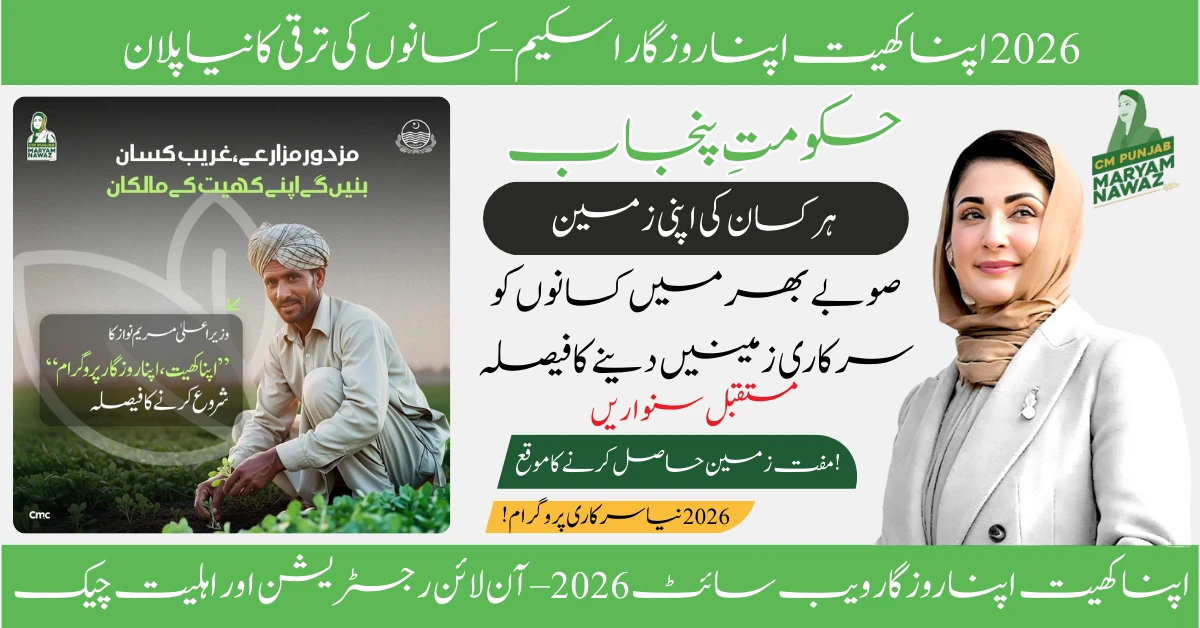
Are you looking for the Apna Khet Apna Rozgar official website link 2026? If you’re a resident of Punjab seeking agricultural land or employment through farming, this comprehensive guide is designed for you. In January 2026, Punjab Chief Minister Maryam Nawaz announced this groundbreaking program, which is set to transform the lives of thousands of Pakistanis by providing government land for agriculture and creating sustainable employment opportunities.
This article provides everything you need to know about the official portal, how to access it, eligibility requirements, application process, and frequently asked questions. Whether you’re a young farmer, an agricultural enthusiast, or someone seeking self-employment through farming, you’ll find all the essential information here.
What Is Apna Khet Apna Rozgar Program 2026?
Apna Khet Apna Rozgar, which translates to “My Field, My Livelihood,” is an ambitious government initiative launched by the Punjab government in 2026. The program aims to provide government-owned agricultural land to 50,000 individuals across Punjab, enabling them to establish sustainable farming businesses and earn independent incomes.
This agricultural employment scheme represents a significant shift in Punjab’s economic policy, focusing on rural development, agricultural productivity, and youth empowerment. Unlike traditional job-seeking, this program encourages entrepreneurship in the farming sector, allowing beneficiaries to become self-reliant while contributing to food security and economic growth.
The initiative is part of Chief Minister Maryam Nawaz’s broader employment strategy, which targets creating over one million jobs in Punjab within two years. By allocating unused or underutilized government land to deserving individuals, the program maximizes resource utilization while addressing unemployment in rural areas.
Apna Khet Apna Rozgar Official Website Link 2026
The official platform for the Apna Khet Apna Rozgar program registration and updates is managed through the Punjab government’s agricultural and employment portals. As of February 2026, registration details and updates are being processed through:
Primary Portal: Punjab Rozgar and Agricultural Development Department websites
Key Official Links:
- https://rozgar.psic.punjab.gov.pk – Punjab Small Industries Corporation (PSIC) Rozgar Portal
- https://pgrkam.com – Punjab Rozgar Department (Ghar Ghar Rozgar and Karobar Mission)
- Official Punjab Government Agriculture Department portal (updates announced regularly)
Important Note: The official website continues to update as the program rolls out across all districts. We recommend regularly checking the official Punjab government website and subscribing to government announcements for real-time updates on registration opening dates, eligibility criteria, and district-wise allocations.
Program Overview and Key Features
| Feature | Details |
|---|---|
| Target Beneficiaries | 50,000 individuals across Punjab (Phase 1) |
| Land Allocation | Government-owned agricultural land in various districts |
| Eligibility | Punjab domicile holders, age 18+, interested in farming |
| Benefits | Free/subsidized land lease, agricultural support, technical guidance |
| Employment Creation | Direct employment + indirect jobs in agricultural sectors |
| Launch Date | Announced January 2026 |
| Processing Status | Implementation underway across districts |
| Application Mode | Online registration (portal activation timeline pending) |
| Associated Benefits | Training programs, market linkages, subsidy on inputs |
Why Was Apna Khet Apna Rozgar Program Launched?
The Punjab government introduced this agricultural employment initiative to address several critical challenges:
Rural Unemployment Crisis
Despite agriculture being the backbone of Punjab’s economy, rural youth migration to urban areas has been increasing. The lack of accessible agricultural land and modern farming opportunities forces young people to leave villages. Apna Khet Apna Rozgar bridges this gap by directly providing land and employment in agriculture.
Food Security and Agricultural Productivity
Pakistan faces growing pressure to ensure food security for its expanding population. By enabling 50,000 new farmers to cultivate government land, the program directly increases agricultural output, reducing the nation’s dependence on food imports and strengthening domestic food production capacity.
Economic Transformation Through Agriculture
Agriculture contributes significantly to Punjab’s GDP, but many rural communities remain economically disadvantaged. By democratizing land access, the program allows underprivileged sectors to participate in agricultural wealth creation, thereby boosting rural economies and increasing local spending on agricultural inputs, equipment, and services.
Youth Empowerment in Farming
The initiative challenges the misconception that farming is an outdated profession. By providing modern farming opportunities with technical support and market linkages, it positions agriculture as a viable career for educated youth, encouraging them to pursue farming with entrepreneurial mindsets.
Broader Employment Goals
The Punjab government aims to create one million jobs within two years. Apna Khet Apna Rozgar is a cornerstone of this vision, creating not just direct employment for farmers but also indirect opportunities in agricultural extension, input supply, food processing, and rural trade sectors.
Eligibility Criteria for Apna Khet Apna Rozgar 2026
To qualify for the Apna Khet Apna Rozgar program, applicants must meet the following requirements:
Basic Eligibility Requirements
- Must be a Pakistani citizen with valid CNIC (National Identity Card)
- Must be a resident of Punjab with valid Punjab domicile
- Minimum age: 18 years
- No upper age limit specified (agriculture welcomes all age groups)
- Must have genuine interest in farming and agricultural activities
Land Eligibility Conditions
- Applicant should not already own agricultural land (preference given to landless individuals)
- Must commit to cultivating the allocated land for minimum specified duration
- Should agree to follow sustainable and modern farming practices
- Must comply with government agricultural standards and regulations
Educational and Professional Background
- No specific educational qualification is mandatory
- Both educated and uneducated individuals can apply
- Farmers with existing agricultural experience are preferred
- Technical training certificates or diplomas in agriculture are advantageous but not required
Financial and Credit History
- Applicant should not have defaulted on previous government loans
- Clear credit record with financial institutions is preferred
- No outstanding liabilities with government institutions
- Ability to arrange inputs and tools for farming (government may provide subsidies)
Documentation Requirements
When applying, applicants typically need to submit:
- Valid CNIC (original and photocopy)
- Proof of Punjab domicile
- Computerized National ID card (CNIC) printout
- Recent passport-sized photographs
- Proof of residence (utility bill or rental agreement)
- Bank account details for fund transfers
- Business plan or farming proposal (for advanced applicants)
How to Apply: Step-by-Step Application Process
The Apna Khet Apna Rozgar application process is designed to be straightforward and user-friendly. Here’s the complete step-by-step guide:
Step 1: Visit the Official Portal
Navigate to the official Punjab government agricultural or rozgar portal. The primary website is https://rozgar.psic.punjab.gov.pk or the dedicated Apna Khet Apna Rozgar registration page (link will be updated when registration opens).
Step 2: Create Your Account
- Click on “New Registration” or “Applicant Signup”
- Enter your CNIC number and create a strong password
- Provide your valid mobile number for SMS notifications and OTP verification
- Set a recovery email address for account security
- Accept terms and conditions
Step 3: Verify Your Account
- An OTP (One-Time Password) will be sent to your registered mobile number
- Enter the OTP on the verification page
- Complete the email verification process
- Your account is now activated and ready
Step 4: Fill Personal and Residential Information
- Enter full name as per CNIC
- Select province (Punjab) and district of residence
- Provide current address with postal code
- Enter contact phone number and email
- Select your occupation and farming experience (if any)
Step 5: Provide Agricultural Information
- Describe your farming interest and background
- Specify types of crops you intend to cultivate
- Mention farm size preference (if available options)
- Provide details of any previous farming experience
- Upload a brief farming proposal or business plan (optional but recommended)
Step 6: Submit Required Documents
Upload the following documents as digital files:
- CNIC front and back (PDF or JPG, not exceeding 5MB)
- Proof of domicile (utility bill or government certificate)
- Recent photograph (passport-sized, clear background)
- Bank account details (account holder statement)
- Any agricultural certificates or training documents
Step 7: Review and Submit Application
- Review all entered information for accuracy
- Ensure all documents are properly uploaded and visible
- Check that contact information is correct
- Click “Submit Application”
- Save your application reference number (this is crucial for tracking)
Step 8: Payment of Processing Fee (if applicable)
- A small processing fee may apply (details to be announced)
- Fee payment may be through bank challan or online payment portal
- Keep fee payment receipt for verification purposes
- Submit the receipt through the portal if required
Step 9: Track Your Application Status
- Use your application reference number to check status
- SMS notifications will be sent at each stage (registration, initial scrutiny, approval)
- Expected timeline: 3 to 6 weeks for verification and approval
- You will be contacted for interviews or additional documents if needed
Step 10: Final Approval and Land Allocation
- Upon approval, you’ll be informed of allocated land location
- Details include land size, district location, and lease terms
- Attendance at briefing sessions may be mandatory
- Collection of land possession documents and keys
Land Allocation and Terms
Land Size and Location
The Apna Khet Apna Rozgar program allocates government-owned agricultural land across Punjab’s districts. While specific details are being finalized, expected allocations include:
- Small plots: 2-5 acres (for new or small-scale farmers)
- Medium plots: 5-10 acres (for experienced farmers with business plans)
- Large plots: 10+ acres (subject to availability and merit)
Land will be distributed across districts based on:
- Availability of suitable government agricultural land
- Population and demand in each district
- Soil quality and irrigation facilities
- Proximity to agricultural markets and input suppliers
Lease and Ownership Terms
- Land is allocated on long-term lease basis (typically 10-20 years)
- Annual lease amount determined by government valuation
- Significantly discounted rates compared to private land market
- Lease can be renewed upon completion of term
- Ownership conditions to be finalized by government
Agricultural Support Provided
Beneficiaries receive more than just land. The program includes:
- Technical Guidance: Agricultural extension officers provide regular field visits and training
- Crop Advisory Services: Government provides crop-specific guidance and seasonal advice
- Input Subsidies: Discounted seeds, fertilizers, and pesticides
- Market Linkages: Connection to government procurement and modern markets
- Training Programs: Short-term courses on modern farming techniques
- Water Access: Irrigation water availability from government sources
- Infrastructure: Basic farm roads and water management systems
Current Status and Timeline for Apna Khet Apna Rozgar 2026
What We Know (As of February 2026)
| Timeline | Development |
|---|---|
| January 24, 2026 | Official announcement by CM Maryam Nawaz in Cabinet meeting |
| January-February 2026 | Implementation framework being finalized by departments |
| February-March 2026 | Expected notification of registration opening date |
| March-April 2026 | Likely online registration period (predicted timeline) |
| April-June 2026 | Verification and scrutiny of applications |
| June-August 2026 | Land allocation and beneficiary selection |
| August onwards | Distribution and possession of allocated land |
Expected Registration Timeline
While official dates haven’t been fully announced, the government has indicated:
- Registration will open online (no offline applications)
- Multiple registration phases to accommodate all 50,000 beneficiaries
- District-wise registration windows to manage demand systematically
- Regular updates will be published on official portals
How to Stay Updated
To receive timely information about registration opening and program updates:
- Visit https://rozgar.psic.punjab.gov.pk regularly
- Follow official Punjab government social media accounts
- Subscribe to government notification channels
- Contact district administration offices for local updates
- Register your email on official portals for automatic notifications
Differences Between Apna Khet Apna Rozgar and Other Government Schemes
Punjab government has introduced multiple employment and land schemes. Here’s how Apna Khet Apna Rozgar differs:
| Aspect | Apna Khet Apna Rozgar | Apni Zameen Apna Ghar | CM Punjab Rozgar Scheme |
|---|---|---|---|
| Focus | Agricultural land for farming | Housing/residential plots | Business loans for startups |
| Primary Beneficiary | Aspiring and existing farmers | Low-income housing seekers | Young entrepreneurs |
| What’s Provided | Agricultural land on lease | Residential land/plot | Business loan (Rs. 100K-10M) |
| Investment Required | Farming inputs and labor | Construction costs | Business investment |
| Employment Type | Agricultural self-employment | Home ownership | Business/entrepreneurship |
| Target Beneficiaries | 50,000 farmers | Housing shortage relief | 200,000+ entrepreneurs |
| Application Process | Agriculture department portal | Housing agency portal | PSIC/Bank of Punjab portal |
| Sustainability | Long-term farming livelihood | Permanent housing asset | Growing business capital |
Benefits of Joining Apna Khet Apna Rozgar Program
Economic Benefits for Farmers
Direct Income Generation: Beneficiaries can earn monthly income from crop sales, with profit margins ranging from 25-50% depending on crop type and market conditions. Many farmers report annual earnings of Rs. 200,000 to Rs. 800,000+ depending on farm size and crop selection.
Asset Building: Long-term land lease provides stable asset for future generations, enabling farmers to plan long-term agricultural businesses and secure loans against farm assets.
Reduced Production Costs: Government subsidies on seeds, fertilizers, and water significantly reduce input costs, improving overall profitability compared to traditional farming.
Community and Social Benefits
Rural Development: Program catalyzes comprehensive rural development through increased agricultural activity, expanded rural markets, and growth of agricultural support services.
Youth Engagement: Young farmers bring innovation, technology adoption, and entrepreneurial mindsets to agriculture, modernizing traditional farming practices.
Family Food Security: Beneficiary families achieve self-sufficiency in food production, improving nutrition and reducing grocery expenses.
Broader Economic Impact
Employment Multiplication: Each farm creates direct employment for the owner-farmer and family members, plus indirect jobs in agricultural inputs, transport, and processing sectors.
Economic Growth: Increased agricultural production contributes to rural GDP growth, strengthens agricultural supply chains, and supports downstream industries like food processing and export.
Food Security Contribution: 50,000 additional farms significantly enhance Pakistan’s agricultural output, improving national food security and reducing import dependency.
Comparison with Private Farming Options
| Factor | Apna Khet Apna Rozgar | Private Agricultural Land |
|---|---|---|
| Initial Investment | Minimal (processing fee + inputs) | Lakhs for land purchase/rent |
| Land Cost | Heavily subsidized lease | Market rate (expensive) |
| Security of Tenure | Government guaranteed (10-20 years) | Subject to contract renewal |
| Technical Support | Free extension services | Self-arranged/costly |
| Input Subsidies | Government provided | None |
| Market Linkages | Government facilitated | Self-arranged |
| Administrative Support | Dedicated government oversight | None |
| Total Entry Cost | Rs. 5,000-50,000 | Rs. 500,000-2,000,000+ |
| Profitability Timeline | 6-12 months | Varies, 1-2 years |
| Long-term Security | High (government backed) | Depends on market |
Success Stories and Expected Outcomes
While the program is newly launched, similar successful agricultural schemes in Punjab and other provinces demonstrate significant potential:
Expected Individual Benefits
Farmers typically report within first year:
- 30-40% increase in agricultural income compared to laborers
- Achievement of food security for entire family
- Ability to invest in children’s education
- Building productive assets for future generations
- Transition from daily wage labor to dignified self-employment
Community-Level Outcomes
In regions where similar programs operated:
- 25-35% reduction in rural unemployment
- Visible improvement in village infrastructure and services
- Emergence of agricultural micro-enterprises (input supply, transport, processing)
- Increased enrollment of rural children in schools
- Strengthened social cohesion through farming cooperatives